Marta Smolińska
Czułość i kły:
Czech, Starska, Nitka i Pająk o / w ryzykownych przestrzeniach współistnienia
Czy można mieć kły i nadal pozostawać czułym? Pytanie to tylko pozornie opiera się na przeciwstawieniu dwóch wykluczających się jakości. Czułość kojarzymy przecież z miękkością, dotykiem, troską i gotowością do zbliżenia się do innej istoty, podczas gdy kły oznaczają groźbę, drapieżność oraz możliwość zranienia. Jedne i drugie wymagają jednak radykalnego skrócenia dystansu. Czułość wydarza się w bezpośrednim sąsiedztwie skóry; kły również muszą znaleźć się blisko ciała, żeby pozostawić w nim ślad. Obie jakości dotyczą zatem przekraczania granic, wystawiania się na kontakt i ryzyka, że ze spotkania z innym nie wyjdziemy niezmienieni. Czułość nie zaczyna się tam, gdzie inna istota chowa kły, lecz tam, gdzie powstrzymujemy się przed żądaniem, aby je dla nas usunęła.
Wystawa Martyny Czech, Magdaleny Starskiej, Zdzisława Nitki i Martyny Pająk wyrasta z tak rozumianego napięcia pomiędzy pragnieniem bliskości a potrzebą obrony własnej odrębności. Przestrzeń Galerii Łazorczyk zapełniają ludzie i zwierzęta, kochankowie, malarze, czaszki, widma, drzewa oraz trudne do rozpoznania organiczne byty. Jedne z nich obejmują się, inne czają, uciekają, prężą się, podglądają lub szczerzą zęby. Jeszcze inne po prostu trwają obok siebie, dzieląc przestrzeń obrazu albo galerii bez konieczności uzgadniania wspólnej tożsamości. Nie tworzą harmonijnej wspólnoty, lecz zbiorowisko istot powiązanych siecią przyciągania, lęku, pożądania, zależności i wzajemnego oddziaływania. Tytułowe kły mogą należeć do psa, wilka, hieny lub lisa, ale także do człowieka, obrazu czy rzeźby. Czułość natomiast nie musi objawiać się gestem pieszczoty. Niekiedy przybiera postać uważnego spojrzenia, podtrzymywania czyjejś obecności albo zgody na to, że inny pozostanie niezrozumiały.
Jedna z czołowych filozofek posthumanistycznych Donna Haraway1 przekonuje, że żadna istota nie powstaje samodzielnie. Nie istniejemy najpierw jako gotowe, szczelnie od siebie oddzielone podmioty, które dopiero później decydują się wejść w relację. Stajemy się tym, kim jesteśmy, poprzez związki z ludźmi, zwierzętami, roślinami, technologiami i materią. Zaproponowane przez filozofkę „stawanie-się-z” nie prowadzi jednak do sentymentalnej wizji pokojowego współistnienia gatunków. Każde spotkanie niesie ze sobą nierówność, zależność i możliwość zranienia; historia udomowienia jest zarazem historią przywiązania i podporządkowania. Bliskość nie usuwa przemocy, podobnie jak konflikt nie wyklucza więzi. Znaczenie relacji polega właśnie na tym, że jej uczestnicy mogą się wzajemnie zmieniać, chociaż nie mają pełnej kontroli nad kierunkiem owej przemiany.
Wyjątkowo bezkompromisowo pokazuje to malarstwo Martyny Czech. Obrazy artystki od dawna wyrastają z emocjonalnej intensywności, która nie poddaje się estetycznej cenzurze. Czech nie wygładza uczuć, lecz pozwala im wykwitać na płótnach wraz z ich niespójnością, gwałtownością, nieprzyzwoitością i lepką cielesnością. Prowadzony pośpiesznie pędzel nie tyle opisuje rzeczywistość, ile wbija się w jej mięso. Postacie zostają zdeformowane, kolory zaostrzone, a gest malarski zachowuje energię afektu, który go wywołał. Miłość nie jawi się tu jako stabilne schronienie przed światem, ale jako siła wystawiająca podmiot na kogoś innego – a więc jednocześnie ożywiająca i niebezpieczna.
Najnowszy cykl Interpunkcja miłości nadaje relacji uczuciowej strukturę języka, lecz nie przekształca jej w uporządkowaną narrację. Poszczególne obrazy noszą zamiast tytułów znaki interpunkcyjne: pytajnik, dwukropek, wykrzyknik, nawias, cudzysłów czy pauzę. Każdy z nich reguluje rytm wypowiedzi, wyznacza moment zawieszenia głosu, zapowiada ciąg dalszy albo odgradza fragment tekstu od reszty. Przeniesione w obszar miłości znaki tracą jednak swoją gramatyczną jednoznaczność. Pytajnik może wyrażać ciekawość drugiej osoby, ale również nieufność. Wykrzyknik oznacza uniesienie, rozkaz lub krzyk bólu. Nawias przypomina ramiona obejmujące ciało, a jednocześnie wydziela to, co uznano za poboczne i możliwe do pominięcia. Cudzysłów przywołuje czyjeś słowa, lecz zarazem podważa ich autentyczność. Pauza może być wspólnym oddechem albo szczeliną, przez którą do związku przedostaje się obcość.
Interpunkcja nie ozdabia więc miłości, lecz ujawnia jej składnię: zmienny układ zbliżeń i oddaleń, dominacji i poddania, mówienia i milczenia. Znak wbija się pomiędzy dwoje ludzi niczym klin, ale bez niego ich wypowiedź rozpłynęłaby się w pozbawionym rytmu strumieniu. Podobnie granica w związku nie musi oznaczać końca bliskości; może być warunkiem pozwalającym dwóm osobom pozostać odrębnymi. Czułość bez respektowania tej granicy łatwo zmienia się w zawłaszczenie. Miłość bez kłów staje się postulatem całkowitego rozbrojenia przed innym, a zatem zgodą na utratę możliwości obrony.
Tę ambiwalencję szczególnie mocno kondensuje Spermowór. Już sam tytuł brutalnie łączy biologiczny konkret z formą pojemnika, sugerując uprzedmiotowienie ciała i sprowadzenie go do funkcji przyjmowania cudzej substancji. Obraz nie pozwala jednak zatrzymać się na jednoznacznym podziale na aktywnego sprawcę i bierne naczynie. Ciało w malarstwie Czech nigdy nie jest całkowicie pasywne: chłonie, ale również trawi; zostaje przeniknięte, lecz przetwarza to, co wtargnęło do jego wnętrza. W podobny sposób działa sama powierzchnia płótna, przyjmująca kolejne warstwy farby i zachowująca ślady nacisku pędzla. Malowanie staje się aktem kontaktu, w którym trudno wyznaczyć granicę pomiędzy czułością a naporem.
W obrazie Mękka miękkość również nie oznacza bezbronnej uległości. Jest zdolnością poddawania się naciskowi bez rozpadu, przyjmowania dotyku i zapamiętywania go we własnej strukturze. To, co miękkie, może ustępować, otaczać, amortyzować i wchłaniać, ale może także oblepiać intruza, unieruchamiać go oraz zmuszać do pozostania wewnątrz. Miękkość okazuje się szczególnym rodzajem siły: nie uderza frontalnie, lecz zmienia kształt i tym sposobem trwa. Jej rewersem pozostaje jednak ranliwość – każde ciało zdolne do odczuwania czułości jest zarazem ciałem, które można zranić.
María Puig de la Bellacasa2 przestrzega, by troski nie utożsamiać z niewinną intencją czynienia dobra. Troska jest materialną praktyką podtrzymywania czyjegoś życia, wymagającą czasu, pracy i zaangażowania, lecz zawsze pozostaje uwikłana w relacje władzy. Można troszczyć się nadmiernie, źle lub wybiórczo; opieka nad jedną istotą może oznaczać zaniedbanie innej. Również miłość u Czech nie oczyszcza relacji z agresji, egoizmu czy pragnienia posiadania. Przeciwnie, zagląda im głęboko w gardło i sprawdza, jakie zęby się w nim kryją. W Cieniu śmierci za dnia życia bliskość istnienia i rozpadu zostaje wpisana w samą strukturę obrazu. Śmierć nie przychodzi po życiu, lecz towarzyszy mu jak cień, wyostrzając zarazem intensywność każdego dotknięcia. Kochamy dlatego, że możemy utracić; chwytamy mocniej właśnie wtedy, gdy czujemy, że druga osoba może się wymknąć.
Z kolei u Magdaleny Starskiej granice pomiędzy czułością i zagrożeniem komplikują się jeszcze bardziej, ponieważ relacje przestają być wyłącznie ludzkie. Jej obrazy przypominają fragmenty mitologii, której reguły nie zostały jeszcze zapisane. Ludzie spotykają się w nich ze zwierzętami, drzewa zyskują spojrzenia, ciała ulegają przeskalowaniu, a zwyczajne gesty przechodzą w baśniowe lub niepokojące rytuały. Nie jest to jednak świat odległy od rzeczywistości. Przeciwnie: fantastyka pozwala Starskiej odsłonić rzeczywiste związki, które antropocentryczny porządek zwykle spycha poza pole widzenia. Człowiek nigdy nie pozostaje sam; za jego plecami stoi zwierzę, pod skórą pracuje obca materia, a pozornie nieruchome otoczenie odpowiada na każdy jego ruch.
Fantastyczne istoty z obrazów Starskiej nie są symbolami, które można bez reszty przełożyć na język ludzkich cech i emocji. Zwierzęta zachowują nieprzejrzystość, która pozwala im wymknąć się alegorycznemu oswojeniu. Bywają znajome, lecz nie przestają być obce; zbliżają się do ludzi, ale nie składają im deklaracji lojalności. Psy pozostają blisko z człowiekiem, lecz trudno rozstrzygnąć, czy przedstawiona scena jest wyrazem czułości, próbą wzajemnego rozpoznania, czy też momentem poprzedzającym ukąszenie. Nos i usta, oddechy i ślina, sierść i skóra spotykają się na granicy gatunków. Gest pozostaje otwarty: może przekształcić się w pocałunek albo w atak. Podobnie pełna napięcia i ambiwalentna jest bliskość aktorów ludzkich i nie-ludzkich w kompozycji Żuk gnojarz i rycerz – zielona sylwetka o pięciu nogach staje się hybrydą człowieczo-chrząszczową, naruszając granice międzygatunkowych światów.
Podobne niejednoznaczności pojawiają się w obrazie Sen żuka-kruka, przedstawiającym wielkie, ciemne zwierzę z białą tkaniną zawiązaną wokół jednej z łap. Inne stworzenia zawisają nad nim lub czają się w mroku. Tkanina wygląda jak opatrunek, fragment ubrania, znak ujarzmienia albo pamiątka po kontakcie z człowiekiem. Nie wiadomo, czy zwierzę zostało zranione, schwytane, czy też właśnie uwalnia się z więzów. Biała materia przyciąga wzrok, ponieważ do zwierzęcego ciała wnosi ślad ludzkiej troski, a zarazem przemocy. Bandaż jest przecież gestem opieki nad raną, lecz jednocześnie świadectwem tego, że rana już istnieje.
Czułość w ujęciu Starskiej nie prowadzi zatem do pojednania człowieka z naturą. Artystka nie maluje utraconego raju, do którego moglibyśmy powrócić po zrzuceniu ciężaru cywilizacji. W gronie przedstawionym na płótnie Zielone ognisko nie zostawiono dla nas miejsca. Światy malowane przez artystkę są zbyt osobliwe, cielesne i pełne napięć, by stać się pocztówkami z międzygatunkowej Arkadii. Zielone, pomarańczowe, brunatne i granatowe stworzenia przepychają się, uciekają, spadają, kopulują lub przywierają do siebie. Często nie sposób orzec, gdzie kończy się jedno ciało, a zaczyna drugie. Czułość jest tutaj zgodą na zamieszkanie w tej niejasności bez natychmiastowego porządkowania jej według znanych hierarchii.
Zgodnie z teorią Vinciane Despret3 zwierzę odpowiada zależnie od tego, jakie pytanie mu zadamy i w jakiej sytuacji je postawimy. Nie jest biernym przedmiotem ludzkiego poznania, lecz współtwórcą spotkania, ponieważ aktywnie obserwuje obserwatora, reaguje na jego gesty i zmienia warunki, w których samo jest oglądane. W obrazach Starskiej spojrzenie również krąży pomiędzy istotami, nie zatrzymując się na człowieku jako uprzywilejowanym centrum. Oczy wyrastają z gęstwiny jak np. w kompozycji Dżeki i lipa, pojawiają się na zwierzęcych pyskach i hybrydycznych ciałach, błyskają spomiędzy drzew. Świat patrzy. Człowiek, przyzwyczajony do roli podmiotu oceniającego inne stworzenia, nagle odkrywa, że sam został zauważony4.
Odwrócenie kierunku spojrzenia dochodzi do głosu również w Zwierzętach obserwowanych Zdzisława Nitki. Tytuł pozornie zachowuje tradycyjny układ władzy: zwierzęta są oglądane, a człowiek pozostaje niewidocznym obserwatorem. Tymczasem zebra kieruje ku nam własne, wyraziste oko, zaś dwie żyrafy przecinają błękitną przestrzeń obrazu niczym samodzielne, płynne znaki. Zwierzęta nie zostały tu metodycznie opisane ani podporządkowane zasadom poprawności anatomicznej. Ich ciała powstają z szerokich, zdecydowanych pociągnięć pędzla i mocnych kontrastów. Zebra jest zarazem zwierzęciem i czarno-białym rytmem malarskim, żyrafy zaś stają się smugami ochry nakrapianymi ciemnymi plamami. Nitka nie ukrywa, że patrząc na zwierzę, zawsze tworzymy również jego obraz – a obraz zaczyna następnie patrzeć na nas.
Malarstwo Nitki świadomie wyrasta z tradycji ekspresjonizmu, szczególnie bliskiej artyście za pośrednictwem Edvarda Muncha, niemieckiej grupy Die Brücke, Ottona Muellera, a później Georga Baselitza. Nie chodzi jednak o stylistyczne naśladownictwo, lecz o podtrzymywanie ekspresjonistycznego przekonania, że deformacja może mówić o świecie prawdziwiej niż mimetyczne podobieństwo. Ostry kontur, dysonansowy kolor i ostentacyjnie widoczny ślad pędzla nie służą dekoracyjności, lecz czujnie rejestrują napięcie pomiędzy ciałem a otoczeniem, człowiekiem a zwierzęciem, życiem a świadomością jego końca. Nitka nie tyle cytuje ekspresjonizm, ile traktuje go jak żywy organizm, który nadal może rosnąć, mutować i szczerzyć zęby.
Dlatego malarscy poprzednicy wchodzą do jego obrazów jako bohaterowie nowych, często groteskowych opowieści. W pracy 1930. Otto Mueller kaszle, przyjechał do Obernigk umrzeć biografia niemieckiego ekspresjonisty zostaje skondensowana w kilku gwałtownych znakach: wychudzonej twarzy, dłoni uniesionej ku ustom, pociągu, czarnym ptaku i niespokojnych pasach czerwieni, błękitu oraz bieli. Kaszel staje się niemal widzialny, jakby przechodził z płuc w rytm kompozycji. Artysta nie buduje pomnikowego portretu Muellera. Przeciwnie, przedstawia go jako kruche, chore ciało, które zmierza ku śmierci, podczas gdy świat nadal pozostaje intensywnie kolorowy. Czułość wobec poprzednika nie polega tutaj na idealizacji, lecz na dopuszczeniu do obrazu jego słabości.
W Munchu! spotkanie z mistrzem ma charakter znacznie bardziej bezceremonialny. Żółta twarz norweskiego artysty, brunatne zwierzę i zapisane bezpośrednio na płótnie nazwisko tworzą rodzaj malarskiego wykrzyknika. Nitka obchodzi się z historią sztuki poufale: wyciąga jej bohaterów z muzealnego dystansu i umieszcza w świecie własnych obsesji. Taka relacja również ma swoje kły. Aby utrzymać tradycję przy życiu, trzeba naruszyć jej nietykalność, przekształcać ją, na(d)gryzać, czasem podać w wątpliwość. Nadmierny respekt może okazać się formą unieruchomienia; dopiero twórcza niewierność pozwala dziełu przodka ponownie działać.
Najbardziej przewrotnie mechanizm ten ujawnia Dzień, w którym umarł Baselitz. Nitka przedstawia fikcyjną lub antycypowaną śmierć artysty, który sam uczynił odwracanie figur jednym z najbardziej rozpoznawalnych gestów powojennego malarstwa. Monumentalna kompozycja nie jest nekrologiem, lecz fantazją o chwili, w której mistrz przechodzi z porządku żywych uczestników sztuki do jej historii. Wokół różowej twarzy spiętrzają się strużki farby, kontury i ślady gwałtownych gestów, jakby obraz przeprowadzał własny rytuał żałobny. Czułość przyjmuje postać hołdu, ale kły przypominają o rywalizacji: każdy malarz pracujący po kimś zarazem coś mu zawdzięcza i próbuje uwolnić się spod jego wpływu.
Z kolei w Turnerze i wiewiórce hierarchia zostaje zachwiana jeszcze radykalniej. Drobne zwierzę urasta do rozmiarów dominujących nad przedstawieniem, podczas gdy malarz pejzażu zostaje zepchnięty ku dolnej krawędzi płótna. Wiewiórka nie jest sztafażem ożywiającym las; to raczej Turner staje się dodatkiem do jej świata. Ogromny ogon zwierzęcia przejmuje rolę malarskiego żywiołu – przypomina płomień, chmurę albo falę, a więc te fenomeny, które fascynowały angielskiego malarza. Nitka układa historię sztuki na nowo, dopuszczając do niej podmioty dotąd pozostające poza kadrem – można odnieść wszak wrażenie, że zwierzę nie tylko wchodzi do obrazu Turnera, lecz przejmuje jego środki.
Jeszcze inaczej bliskość zostaje przedstawiona w Nocnych kochankach. Dwie wydłużone, blade twarze przylegają do siebie na tle czerni, lecz ich spojrzenia nie spotykają się. Para trwa razem, a zarazem każde z kochanków pozostaje zamknięte we własnej melancholii. Podział płótna na trzy części sprawia, że postacie wydają się jednocześnie scalone i pocięte. Ich ciała zostają dopasowane do wspólnego układu, ale nie stapiają się w jedno. To czułość pozbawiona iluzji całkowitego porozumienia: bycie obok kogoś, którego wnętrze pozostanie ostatecznie niedostępne.
Do tego wielogłosowego chóru rzeźby Martyny Pająk wprowadzają natomiast do obecność pozbawioną jednoznacznie rozpoznawalnej twarzy – wszak nawet Meduza jej nie ma. Artystka tworzy organiczne formy, które zdają się oddychać, pęcznieć, kurczyć albo osłaniać własne wnętrza. Czasami – jak Rzeźby oddechowe – przypominają fragment szkieletu, żebrowanie, kokon, narząd lub nieznane stworzenie; nigdy jednak nie pozwalają zatrzymać się przy jednym rozpoznaniu. Ich cielesność nie wynika z mimetycznego podobieństwa do organizmu, lecz z odczuwanej niemal podskórnie energii procesów: wzrostu, nacisku, przepływu i przemiany.
W spotkaniu z rzeźbami Pająk oko przestaje działać z dystansu i uruchamia swoje możliwości haptyczne. Wzrok ślizga się po wypukłościach, zapada w szczeliny, napotyka żebra, fałdy i naprężenia. Dotyka, choć ręka pozostaje nieruchoma. Formy wydają się miękkie i podatne, lecz pod powierzchnią kumulują opór, ponieważ ich krawędzie, pancerze i wewnętrzne rusztowania troskliwie i z przekonaniem chronią coś, czego nie możemy zobaczyć ani całkowicie poznać.
Czułość wobec takich rzeźb polega na powstrzymaniu potrzeby natychmiastowego nazwania ich i podporządkowania znanym kategoriom. Trzeba pozwolić im pozostać niejasnymi, nie rozstrzygać, czy są całymi ciałami, ich fragmentami, żywymi organizmami czy jedynie materią, która przyjęła organiczny kształt. Ta niejednoznaczność sprawia, że rzeźby takie jak Widzimy się czy Miło było zachowują własną podmiotowość i nie stają się wyłącznie powierzchniami ludzkich projekcji.
Prace Czech, Starskiej, Nitki i Pająk spotykają się zatem w miejscu, w którym bliskość traci niewinność. Ich ludzie, zwierzęta i organiczne byty pragną siebie, obserwują się, dotykają, podtrzymują i ranią. Żadne z nich nie istnieje osobno, lecz żadne nie powinno też zostać całkowicie wchłonięte przez relację. Czułość nie usuwa kłów, ponieważ bez nich spotkanie zmieniłoby się w asymilację bezbronnego innego. Kły natomiast nie przekreślają czułości: wyznaczają granicę, dzięki której bliskość nie musi oznaczać rezygnacji z siebie.
Można więc przyjąć, że najczulszym gestem wobec innej istoty – niezależnie, czy ludzkiej czy nie-ludzkiej – nie jest jej oswojenie, lecz uznanie, że zawsze pozostanie w niej coś dzikiego, nieprzejrzystego i zdolnego do oporu. Wystawa nie proponuje spokojnej wspólnoty ludzi, zwierząt i rzeczy. Buduje raczej przestrzeń ryzykownego współistnienia, w której spojrzenie może stać się dotykiem, pieszczota pozostawić ranę, a wyszczerzone zęby oznaczać zarówno ostrzeżenie, jak i uśmiech. Czułość i kły wyrastają tu po prostu z ciała, które jest zdolne zarówno do delikatności, jak i brutalności.
1 Zob.: Donna J. Haraway, When Species Meet, Minneapolis–London: University of Minnesota Press 2008.
2 Por.: María Puig de la Bellacasa, Matters of Care: Speculative Ethics in More Than Human Worlds, Minneapolis–London: University of Minnesota Press 2017, s. 1–7, 69–92, 161–173.
3 Vinciane Despret, The Body We Care For: Figures of Anthropo-zoo-genesis, „Body & Society” 2004, t. 10, nr 2–3, s. 111–134, szczególnie s. 115–120, 122–132.
4 Por.: Jacques Derrida, The Animal That Therefore I Am, red. Marie-Louise Mallet, przeł. David Wills, New York: Fordham University Press 2008, s. 3–5, 11–13.
Marta Smolińska
Czułość i kły:
Czech, Starska, Nitka i Pająk o / w ryzykownych przestrzeniach współistnienia
Czy można mieć kły i nadal pozostawać czułym? Pytanie to tylko pozornie opiera się na przeciwstawieniu dwóch wykluczających się jakości. Czułość kojarzymy przecież z miękkością, dotykiem, troską i gotowością do zbliżenia się do innej istoty, podczas gdy kły oznaczają groźbę, drapieżność oraz możliwość zranienia. Jedne i drugie wymagają jednak radykalnego skrócenia dystansu. Czułość wydarza się w bezpośrednim sąsiedztwie skóry; kły również muszą znaleźć się blisko ciała, żeby pozostawić w nim ślad. Obie jakości dotyczą zatem przekraczania granic, wystawiania się na kontakt i ryzyka, że ze spotkania z innym nie wyjdziemy niezmienieni. Czułość nie zaczyna się tam, gdzie inna istota chowa kły, lecz tam, gdzie powstrzymujemy się przed żądaniem, aby je dla nas usunęła.
Wystawa Martyny Czech, Magdaleny Starskiej, Zdzisława Nitki i Martyny Pająk wyrasta z tak rozumianego napięcia pomiędzy pragnieniem bliskości a potrzebą obrony własnej odrębności. Przestrzeń Galerii Łazorczyk zapełniają ludzie i zwierzęta, kochankowie, malarze, czaszki, widma, drzewa oraz trudne do rozpoznania organiczne byty. Jedne z nich obejmują się, inne czają, uciekają, prężą się, podglądają lub szczerzą zęby. Jeszcze inne po prostu trwają obok siebie, dzieląc przestrzeń obrazu albo galerii bez konieczności uzgadniania wspólnej tożsamości. Nie tworzą harmonijnej wspólnoty, lecz zbiorowisko istot powiązanych siecią przyciągania, lęku, pożądania, zależności i wzajemnego oddziaływania. Tytułowe kły mogą należeć do psa, wilka, hieny lub lisa, ale także do człowieka, obrazu czy rzeźby. Czułość natomiast nie musi objawiać się gestem pieszczoty. Niekiedy przybiera postać uważnego spojrzenia, podtrzymywania czyjejś obecności albo zgody na to, że inny pozostanie niezrozumiały.
Jedna z czołowych filozofek posthumanistycznych Donna Haraway1 przekonuje, że żadna istota nie powstaje samodzielnie. Nie istniejemy najpierw jako gotowe, szczelnie od siebie oddzielone podmioty, które dopiero później decydują się wejść w relację. Stajemy się tym, kim jesteśmy, poprzez związki z ludźmi, zwierzętami, roślinami, technologiami i materią. Zaproponowane przez filozofkę „stawanie-się-z” nie prowadzi jednak do sentymentalnej wizji pokojowego współistnienia gatunków. Każde spotkanie niesie ze sobą nierówność, zależność i możliwość zranienia; historia udomowienia jest zarazem historią przywiązania i podporządkowania. Bliskość nie usuwa przemocy, podobnie jak konflikt nie wyklucza więzi. Znaczenie relacji polega właśnie na tym, że jej uczestnicy mogą się wzajemnie zmieniać, chociaż nie mają pełnej kontroli nad kierunkiem owej przemiany.
Wyjątkowo bezkompromisowo pokazuje to malarstwo Martyny Czech. Obrazy artystki od dawna wyrastają z emocjonalnej intensywności, która nie poddaje się estetycznej cenzurze. Czech nie wygładza uczuć, lecz pozwala im wykwitać na płótnach wraz z ich niespójnością, gwałtownością, nieprzyzwoitością i lepką cielesnością. Prowadzony pośpiesznie pędzel nie tyle opisuje rzeczywistość, ile wbija się w jej mięso. Postacie zostają zdeformowane, kolory zaostrzone, a gest malarski zachowuje energię afektu, który go wywołał. Miłość nie jawi się tu jako stabilne schronienie przed światem, ale jako siła wystawiająca podmiot na kogoś innego – a więc jednocześnie ożywiająca i niebezpieczna.
Najnowszy cykl Interpunkcja miłości nadaje relacji uczuciowej strukturę języka, lecz nie przekształca jej w uporządkowaną narrację. Poszczególne obrazy noszą zamiast tytułów znaki interpunkcyjne: pytajnik, dwukropek, wykrzyknik, nawias, cudzysłów czy pauzę. Każdy z nich reguluje rytm wypowiedzi, wyznacza moment zawieszenia głosu, zapowiada ciąg dalszy albo odgradza fragment tekstu od reszty. Przeniesione w obszar miłości znaki tracą jednak swoją gramatyczną jednoznaczność. Pytajnik może wyrażać ciekawość drugiej osoby, ale również nieufność. Wykrzyknik oznacza uniesienie, rozkaz lub krzyk bólu. Nawias przypomina ramiona obejmujące ciało, a jednocześnie wydziela to, co uznano za poboczne i możliwe do pominięcia. Cudzysłów przywołuje czyjeś słowa, lecz zarazem podważa ich autentyczność. Pauza może być wspólnym oddechem albo szczeliną, przez którą do związku przedostaje się obcość.
Interpunkcja nie ozdabia więc miłości, lecz ujawnia jej składnię: zmienny układ zbliżeń i oddaleń, dominacji i poddania, mówienia i milczenia. Znak wbija się pomiędzy dwoje ludzi niczym klin, ale bez niego ich wypowiedź rozpłynęłaby się w pozbawionym rytmu strumieniu. Podobnie granica w związku nie musi oznaczać końca bliskości; może być warunkiem pozwalającym dwóm osobom pozostać odrębnymi. Czułość bez respektowania tej granicy łatwo zmienia się w zawłaszczenie. Miłość bez kłów staje się postulatem całkowitego rozbrojenia przed innym, a zatem zgodą na utratę możliwości obrony.
Tę ambiwalencję szczególnie mocno kondensuje Spermowór. Już sam tytuł brutalnie łączy biologiczny konkret z formą pojemnika, sugerując uprzedmiotowienie ciała i sprowadzenie go do funkcji przyjmowania cudzej substancji. Obraz nie pozwala jednak zatrzymać się na jednoznacznym podziale na aktywnego sprawcę i bierne naczynie. Ciało w malarstwie Czech nigdy nie jest całkowicie pasywne: chłonie, ale również trawi; zostaje przeniknięte, lecz przetwarza to, co wtargnęło do jego wnętrza. W podobny sposób działa sama powierzchnia płótna, przyjmująca kolejne warstwy farby i zachowująca ślady nacisku pędzla. Malowanie staje się aktem kontaktu, w którym trudno wyznaczyć granicę pomiędzy czułością a naporem.
W obrazie Mękka miękkość również nie oznacza bezbronnej uległości. Jest zdolnością poddawania się naciskowi bez rozpadu, przyjmowania dotyku i zapamiętywania go we własnej strukturze. To, co miękkie, może ustępować, otaczać, amortyzować i wchłaniać, ale może także oblepiać intruza, unieruchamiać go oraz zmuszać do pozostania wewnątrz. Miękkość okazuje się szczególnym rodzajem siły: nie uderza frontalnie, lecz zmienia kształt i tym sposobem trwa. Jej rewersem pozostaje jednak ranliwość – każde ciało zdolne do odczuwania czułości jest zarazem ciałem, które można zranić.
María Puig de la Bellacasa2 przestrzega, by troski nie utożsamiać z niewinną intencją czynienia dobra. Troska jest materialną praktyką podtrzymywania czyjegoś życia, wymagającą czasu, pracy i zaangażowania, lecz zawsze pozostaje uwikłana w relacje władzy. Można troszczyć się nadmiernie, źle lub wybiórczo; opieka nad jedną istotą może oznaczać zaniedbanie innej. Również miłość u Czech nie oczyszcza relacji z agresji, egoizmu czy pragnienia posiadania. Przeciwnie, zagląda im głęboko w gardło i sprawdza, jakie zęby się w nim kryją. W Cieniu śmierci za dnia życia bliskość istnienia i rozpadu zostaje wpisana w samą strukturę obrazu. Śmierć nie przychodzi po życiu, lecz towarzyszy mu jak cień, wyostrzając zarazem intensywność każdego dotknięcia. Kochamy dlatego, że możemy utracić; chwytamy mocniej właśnie wtedy, gdy czujemy, że druga osoba może się wymknąć.
Z kolei u Magdaleny Starskiej granice pomiędzy czułością i zagrożeniem komplikują się jeszcze bardziej, ponieważ relacje przestają być wyłącznie ludzkie. Jej obrazy przypominają fragmenty mitologii, której reguły nie zostały jeszcze zapisane. Ludzie spotykają się w nich ze zwierzętami, drzewa zyskują spojrzenia, ciała ulegają przeskalowaniu, a zwyczajne gesty przechodzą w baśniowe lub niepokojące rytuały. Nie jest to jednak świat odległy od rzeczywistości. Przeciwnie: fantastyka pozwala Starskiej odsłonić rzeczywiste związki, które antropocentryczny porządek zwykle spycha poza pole widzenia. Człowiek nigdy nie pozostaje sam; za jego plecami stoi zwierzę, pod skórą pracuje obca materia, a pozornie nieruchome otoczenie odpowiada na każdy jego ruch.
Fantastyczne istoty z obrazów Starskiej nie są symbolami, które można bez reszty przełożyć na język ludzkich cech i emocji. Zwierzęta zachowują nieprzejrzystość, która pozwala im wymknąć się alegorycznemu oswojeniu. Bywają znajome, lecz nie przestają być obce; zbliżają się do ludzi, ale nie składają im deklaracji lojalności. Psy pozostają blisko z człowiekiem, lecz trudno rozstrzygnąć, czy przedstawiona scena jest wyrazem czułości, próbą wzajemnego rozpoznania, czy też momentem poprzedzającym ukąszenie. Nos i usta, oddechy i ślina, sierść i skóra spotykają się na granicy gatunków. Gest pozostaje otwarty: może przekształcić się w pocałunek albo w atak. Podobnie pełna napięcia i ambiwalentna jest bliskość aktorów ludzkich i nie-ludzkich w kompozycji Żuk gnojarz i rycerz – zielona sylwetka o pięciu nogach staje się hybrydą człowieczo-chrząszczową, naruszając granice międzygatunkowych światów.
Podobne niejednoznaczności pojawiają się w obrazie Sen żuka-kruka, przedstawiającym wielkie, ciemne zwierzę z białą tkaniną zawiązaną wokół jednej z łap. Inne stworzenia zawisają nad nim lub czają się w mroku. Tkanina wygląda jak opatrunek, fragment ubrania, znak ujarzmienia albo pamiątka po kontakcie z człowiekiem. Nie wiadomo, czy zwierzę zostało zranione, schwytane, czy też właśnie uwalnia się z więzów. Biała materia przyciąga wzrok, ponieważ do zwierzęcego ciała wnosi ślad ludzkiej troski, a zarazem przemocy. Bandaż jest przecież gestem opieki nad raną, lecz jednocześnie świadectwem tego, że rana już istnieje.
Czułość w ujęciu Starskiej nie prowadzi zatem do pojednania człowieka z naturą. Artystka nie maluje utraconego raju, do którego moglibyśmy powrócić po zrzuceniu ciężaru cywilizacji. W gronie przedstawionym na płótnie Zielone ognisko nie zostawiono dla nas miejsca. Światy malowane przez artystkę są zbyt osobliwe, cielesne i pełne napięć, by stać się pocztówkami z międzygatunkowej Arkadii. Zielone, pomarańczowe, brunatne i granatowe stworzenia przepychają się, uciekają, spadają, kopulują lub przywierają do siebie. Często nie sposób orzec, gdzie kończy się jedno ciało, a zaczyna drugie. Czułość jest tutaj zgodą na zamieszkanie w tej niejasności bez natychmiastowego porządkowania jej według znanych hierarchii.
Zgodnie z teorią Vinciane Despret3 zwierzę odpowiada zależnie od tego, jakie pytanie mu zadamy i w jakiej sytuacji je postawimy. Nie jest biernym przedmiotem ludzkiego poznania, lecz współtwórcą spotkania, ponieważ aktywnie obserwuje obserwatora, reaguje na jego gesty i zmienia warunki, w których samo jest oglądane. W obrazach Starskiej spojrzenie również krąży pomiędzy istotami, nie zatrzymując się na człowieku jako uprzywilejowanym centrum. Oczy wyrastają z gęstwiny jak np. w kompozycji Dżeki i lipa, pojawiają się na zwierzęcych pyskach i hybrydycznych ciałach, błyskają spomiędzy drzew. Świat patrzy. Człowiek, przyzwyczajony do roli podmiotu oceniającego inne stworzenia, nagle odkrywa, że sam został zauważony4.
Odwrócenie kierunku spojrzenia dochodzi do głosu również w Zwierzętach obserwowanych Zdzisława Nitki. Tytuł pozornie zachowuje tradycyjny układ władzy: zwierzęta są oglądane, a człowiek pozostaje niewidocznym obserwatorem. Tymczasem zebra kieruje ku nam własne, wyraziste oko, zaś dwie żyrafy przecinają błękitną przestrzeń obrazu niczym samodzielne, płynne znaki. Zwierzęta nie zostały tu metodycznie opisane ani podporządkowane zasadom poprawności anatomicznej. Ich ciała powstają z szerokich, zdecydowanych pociągnięć pędzla i mocnych kontrastów. Zebra jest zarazem zwierzęciem i czarno-białym rytmem malarskim, żyrafy zaś stają się smugami ochry nakrapianymi ciemnymi plamami. Nitka nie ukrywa, że patrząc na zwierzę, zawsze tworzymy również jego obraz – a obraz zaczyna następnie patrzeć na nas.
Malarstwo Nitki świadomie wyrasta z tradycji ekspresjonizmu, szczególnie bliskiej artyście za pośrednictwem Edvarda Muncha, niemieckiej grupy Die Brücke, Ottona Muellera, a później Georga Baselitza. Nie chodzi jednak o stylistyczne naśladownictwo, lecz o podtrzymywanie ekspresjonistycznego przekonania, że deformacja może mówić o świecie prawdziwiej niż mimetyczne podobieństwo. Ostry kontur, dysonansowy kolor i ostentacyjnie widoczny ślad pędzla nie służą dekoracyjności, lecz czujnie rejestrują napięcie pomiędzy ciałem a otoczeniem, człowiekiem a zwierzęciem, życiem a świadomością jego końca. Nitka nie tyle cytuje ekspresjonizm, ile traktuje go jak żywy organizm, który nadal może rosnąć, mutować i szczerzyć zęby.
Dlatego malarscy poprzednicy wchodzą do jego obrazów jako bohaterowie nowych, często groteskowych opowieści. W pracy 1930. Otto Mueller kaszle, przyjechał do Obernigk umrzeć biografia niemieckiego ekspresjonisty zostaje skondensowana w kilku gwałtownych znakach: wychudzonej twarzy, dłoni uniesionej ku ustom, pociągu, czarnym ptaku i niespokojnych pasach czerwieni, błękitu oraz bieli. Kaszel staje się niemal widzialny, jakby przechodził z płuc w rytm kompozycji. Artysta nie buduje pomnikowego portretu Muellera. Przeciwnie, przedstawia go jako kruche, chore ciało, które zmierza ku śmierci, podczas gdy świat nadal pozostaje intensywnie kolorowy. Czułość wobec poprzednika nie polega tutaj na idealizacji, lecz na dopuszczeniu do obrazu jego słabości.
W Munchu! spotkanie z mistrzem ma charakter znacznie bardziej bezceremonialny. Żółta twarz norweskiego artysty, brunatne zwierzę i zapisane bezpośrednio na płótnie nazwisko tworzą rodzaj malarskiego wykrzyknika. Nitka obchodzi się z historią sztuki poufale: wyciąga jej bohaterów z muzealnego dystansu i umieszcza w świecie własnych obsesji. Taka relacja również ma swoje kły. Aby utrzymać tradycję przy życiu, trzeba naruszyć jej nietykalność, przekształcać ją, na(d)gryzać, czasem podać w wątpliwość. Nadmierny respekt może okazać się formą unieruchomienia; dopiero twórcza niewierność pozwala dziełu przodka ponownie działać.
Najbardziej przewrotnie mechanizm ten ujawnia Dzień, w którym umarł Baselitz. Nitka przedstawia fikcyjną lub antycypowaną śmierć artysty, który sam uczynił odwracanie figur jednym z najbardziej rozpoznawalnych gestów powojennego malarstwa. Monumentalna kompozycja nie jest nekrologiem, lecz fantazją o chwili, w której mistrz przechodzi z porządku żywych uczestników sztuki do jej historii. Wokół różowej twarzy spiętrzają się strużki farby, kontury i ślady gwałtownych gestów, jakby obraz przeprowadzał własny rytuał żałobny. Czułość przyjmuje postać hołdu, ale kły przypominają o rywalizacji: każdy malarz pracujący po kimś zarazem coś mu zawdzięcza i próbuje uwolnić się spod jego wpływu.
Z kolei w Turnerze i wiewiórce hierarchia zostaje zachwiana jeszcze radykalniej. Drobne zwierzę urasta do rozmiarów dominujących nad przedstawieniem, podczas gdy malarz pejzażu zostaje zepchnięty ku dolnej krawędzi płótna. Wiewiórka nie jest sztafażem ożywiającym las; to raczej Turner staje się dodatkiem do jej świata. Ogromny ogon zwierzęcia przejmuje rolę malarskiego żywiołu – przypomina płomień, chmurę albo falę, a więc te fenomeny, które fascynowały angielskiego malarza. Nitka układa historię sztuki na nowo, dopuszczając do niej podmioty dotąd pozostające poza kadrem – można odnieść wszak wrażenie, że zwierzę nie tylko wchodzi do obrazu Turnera, lecz przejmuje jego środki.
Jeszcze inaczej bliskość zostaje przedstawiona w Nocnych kochankach. Dwie wydłużone, blade twarze przylegają do siebie na tle czerni, lecz ich spojrzenia nie spotykają się. Para trwa razem, a zarazem każde z kochanków pozostaje zamknięte we własnej melancholii. Podział płótna na trzy części sprawia, że postacie wydają się jednocześnie scalone i pocięte. Ich ciała zostają dopasowane do wspólnego układu, ale nie stapiają się w jedno. To czułość pozbawiona iluzji całkowitego porozumienia: bycie obok kogoś, którego wnętrze pozostanie ostatecznie niedostępne.
Do tego wielogłosowego chóru rzeźby Martyny Pająk wprowadzają natomiast do obecność pozbawioną jednoznacznie rozpoznawalnej twarzy – wszak nawet Meduza jej nie ma. Artystka tworzy organiczne formy, które zdają się oddychać, pęcznieć, kurczyć albo osłaniać własne wnętrza. Czasami – jak Rzeźby oddechowe – przypominają fragment szkieletu, żebrowanie, kokon, narząd lub nieznane stworzenie; nigdy jednak nie pozwalają zatrzymać się przy jednym rozpoznaniu. Ich cielesność nie wynika z mimetycznego podobieństwa do organizmu, lecz z odczuwanej niemal podskórnie energii procesów: wzrostu, nacisku, przepływu i przemiany.
W spotkaniu z rzeźbami Pająk oko przestaje działać z dystansu i uruchamia swoje możliwości haptyczne. Wzrok ślizga się po wypukłościach, zapada w szczeliny, napotyka żebra, fałdy i naprężenia. Dotyka, choć ręka pozostaje nieruchoma. Formy wydają się miękkie i podatne, lecz pod powierzchnią kumulują opór, ponieważ ich krawędzie, pancerze i wewnętrzne rusztowania troskliwie i z przekonaniem chronią coś, czego nie możemy zobaczyć ani całkowicie poznać.
Czułość wobec takich rzeźb polega na powstrzymaniu potrzeby natychmiastowego nazwania ich i podporządkowania znanym kategoriom. Trzeba pozwolić im pozostać niejasnymi, nie rozstrzygać, czy są całymi ciałami, ich fragmentami, żywymi organizmami czy jedynie materią, która przyjęła organiczny kształt. Ta niejednoznaczność sprawia, że rzeźby takie jak Widzimy się czy Miło było zachowują własną podmiotowość i nie stają się wyłącznie powierzchniami ludzkich projekcji.
Prace Czech, Starskiej, Nitki i Pająk spotykają się zatem w miejscu, w którym bliskość traci niewinność. Ich ludzie, zwierzęta i organiczne byty pragną siebie, obserwują się, dotykają, podtrzymują i ranią. Żadne z nich nie istnieje osobno, lecz żadne nie powinno też zostać całkowicie wchłonięte przez relację. Czułość nie usuwa kłów, ponieważ bez nich spotkanie zmieniłoby się w asymilację bezbronnego innego. Kły natomiast nie przekreślają czułości: wyznaczają granicę, dzięki której bliskość nie musi oznaczać rezygnacji z siebie.
Można więc przyjąć, że najczulszym gestem wobec innej istoty – niezależnie, czy ludzkiej czy nie-ludzkiej – nie jest jej oswojenie, lecz uznanie, że zawsze pozostanie w niej coś dzikiego, nieprzejrzystego i zdolnego do oporu. Wystawa nie proponuje spokojnej wspólnoty ludzi, zwierząt i rzeczy. Buduje raczej przestrzeń ryzykownego współistnienia, w której spojrzenie może stać się dotykiem, pieszczota pozostawić ranę, a wyszczerzone zęby oznaczać zarówno ostrzeżenie, jak i uśmiech. Czułość i kły wyrastają tu po prostu z ciała, które jest zdolne zarówno do delikatności, jak i brutalności.
1 Zob.: Donna J. Haraway, When Species Meet, Minneapolis–London: University of Minnesota Press 2008.
2 Por.: María Puig de la Bellacasa, Matters of Care: Speculative Ethics in More Than Human Worlds, Minneapolis–London: University of Minnesota Press 2017, s. 1–7, 69–92, 161–173.
3 Vinciane Despret, The Body We Care For: Figures of Anthropo-zoo-genesis, „Body & Society” 2004, t. 10, nr 2–3, s. 111–134, szczególnie s. 115–120, 122–132.
4 Por.: Jacques Derrida, The Animal That Therefore I Am, red. Marie-Louise Mallet, przeł. David Wills, New York: Fordham University Press 2008, s. 3–5, 11–13.
Marta Smolińska
Czułość i kły:
Czech, Starska, Nitka i Pająk o / w ryzykownych przestrzeniach współistnienia
Czy można mieć kły i nadal pozostawać czułym? Pytanie to tylko pozornie opiera się na przeciwstawieniu dwóch wykluczających się jakości. Czułość kojarzymy przecież z miękkością, dotykiem, troską i gotowością do zbliżenia się do innej istoty, podczas gdy kły oznaczają groźbę, drapieżność oraz możliwość zranienia. Jedne i drugie wymagają jednak radykalnego skrócenia dystansu. Czułość wydarza się w bezpośrednim sąsiedztwie skóry; kły również muszą znaleźć się blisko ciała, żeby pozostawić w nim ślad. Obie jakości dotyczą zatem przekraczania granic, wystawiania się na kontakt i ryzyka, że ze spotkania z innym nie wyjdziemy niezmienieni. Czułość nie zaczyna się tam, gdzie inna istota chowa kły, lecz tam, gdzie powstrzymujemy się przed żądaniem, aby je dla nas usunęła.
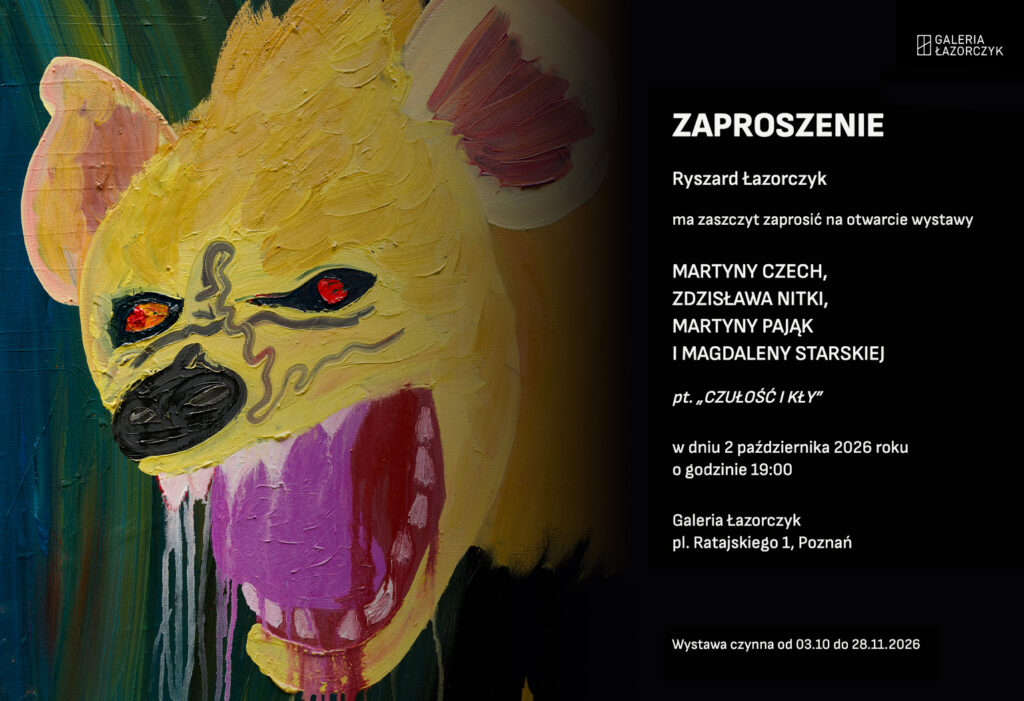
Wystawa Martyny Czech, Magdaleny Starskiej, Zdzisława Nitki i Martyny Pająk wyrasta z tak rozumianego napięcia pomiędzy pragnieniem bliskości a potrzebą obrony własnej odrębności. Przestrzeń Galerii Łazorczyk zapełniają ludzie i zwierzęta, kochankowie, malarze, czaszki, widma, drzewa oraz trudne do rozpoznania organiczne byty. Jedne z nich obejmują się, inne czają, uciekają, prężą się, podglądają lub szczerzą zęby. Jeszcze inne po prostu trwają obok siebie, dzieląc przestrzeń obrazu albo galerii bez konieczności uzgadniania wspólnej tożsamości. Nie tworzą harmonijnej wspólnoty, lecz zbiorowisko istot powiązanych siecią przyciągania, lęku, pożądania, zależności i wzajemnego oddziaływania. Tytułowe kły mogą należeć do psa, wilka, hieny lub lisa, ale także do człowieka, obrazu czy rzeźby. Czułość natomiast nie musi objawiać się gestem pieszczoty. Niekiedy przybiera postać uważnego spojrzenia, podtrzymywania czyjejś obecności albo zgody na to, że inny pozostanie niezrozumiały.
Jedna z czołowych filozofek posthumanistycznych Donna Haraway1 przekonuje, że żadna istota nie powstaje samodzielnie. Nie istniejemy najpierw jako gotowe, szczelnie od siebie oddzielone podmioty, które dopiero później decydują się wejść w relację. Stajemy się tym, kim jesteśmy, poprzez związki z ludźmi, zwierzętami, roślinami, technologiami i materią. Zaproponowane przez filozofkę „stawanie-się-z” nie prowadzi jednak do sentymentalnej wizji pokojowego współistnienia gatunków. Każde spotkanie niesie ze sobą nierówność, zależność i możliwość zranienia; historia udomowienia jest zarazem historią przywiązania i podporządkowania. Bliskość nie usuwa przemocy, podobnie jak konflikt nie wyklucza więzi. Znaczenie relacji polega właśnie na tym, że jej uczestnicy mogą się wzajemnie zmieniać, chociaż nie mają pełnej kontroli nad kierunkiem owej przemiany.
Wyjątkowo bezkompromisowo pokazuje to malarstwo Martyny Czech. Obrazy artystki od dawna wyrastają z emocjonalnej intensywności, która nie poddaje się estetycznej cenzurze. Czech nie wygładza uczuć, lecz pozwala im wykwitać na płótnach wraz z ich niespójnością, gwałtownością, nieprzyzwoitością i lepką cielesnością. Prowadzony pośpiesznie pędzel nie tyle opisuje rzeczywistość, ile wbija się w jej mięso. Postacie zostają zdeformowane, kolory zaostrzone, a gest malarski zachowuje energię afektu, który go wywołał. Miłość nie jawi się tu jako stabilne schronienie przed światem, ale jako siła wystawiająca podmiot na kogoś innego – a więc jednocześnie ożywiająca i niebezpieczna.
Najnowszy cykl Interpunkcja miłości nadaje relacji uczuciowej strukturę języka, lecz nie przekształca jej w uporządkowaną narrację. Poszczególne obrazy noszą zamiast tytułów znaki interpunkcyjne: pytajnik, dwukropek, wykrzyknik, nawias, cudzysłów czy pauzę. Każdy z nich reguluje rytm wypowiedzi, wyznacza moment zawieszenia głosu, zapowiada ciąg dalszy albo odgradza fragment tekstu od reszty. Przeniesione w obszar miłości znaki tracą jednak swoją gramatyczną jednoznaczność. Pytajnik może wyrażać ciekawość drugiej osoby, ale również nieufność. Wykrzyknik oznacza uniesienie, rozkaz lub krzyk bólu. Nawias przypomina ramiona obejmujące ciało, a jednocześnie wydziela to, co uznano za poboczne i możliwe do pominięcia. Cudzysłów przywołuje czyjeś słowa, lecz zarazem podważa ich autentyczność. Pauza może być wspólnym oddechem albo szczeliną, przez którą do związku przedostaje się obcość.
Interpunkcja nie ozdabia więc miłości, lecz ujawnia jej składnię: zmienny układ zbliżeń i oddaleń, dominacji i poddania, mówienia i milczenia. Znak wbija się pomiędzy dwoje ludzi niczym klin, ale bez niego ich wypowiedź rozpłynęłaby się w pozbawionym rytmu strumieniu. Podobnie granica w związku nie musi oznaczać końca bliskości; może być warunkiem pozwalającym dwóm osobom pozostać odrębnymi. Czułość bez respektowania tej granicy łatwo zmienia się w zawłaszczenie. Miłość bez kłów staje się postulatem całkowitego rozbrojenia przed innym, a zatem zgodą na utratę możliwości obrony.
Tę ambiwalencję szczególnie mocno kondensuje Spermowór. Już sam tytuł brutalnie łączy biologiczny konkret z formą pojemnika, sugerując uprzedmiotowienie ciała i sprowadzenie go do funkcji przyjmowania cudzej substancji. Obraz nie pozwala jednak zatrzymać się na jednoznacznym podziale na aktywnego sprawcę i bierne naczynie. Ciało w malarstwie Czech nigdy nie jest całkowicie pasywne: chłonie, ale również trawi; zostaje przeniknięte, lecz przetwarza to, co wtargnęło do jego wnętrza. W podobny sposób działa sama powierzchnia płótna, przyjmująca kolejne warstwy farby i zachowująca ślady nacisku pędzla. Malowanie staje się aktem kontaktu, w którym trudno wyznaczyć granicę pomiędzy czułością a naporem.
W obrazie Mękka miękkość również nie oznacza bezbronnej uległości. Jest zdolnością poddawania się naciskowi bez rozpadu, przyjmowania dotyku i zapamiętywania go we własnej strukturze. To, co miękkie, może ustępować, otaczać, amortyzować i wchłaniać, ale może także oblepiać intruza, unieruchamiać go oraz zmuszać do pozostania wewnątrz. Miękkość okazuje się szczególnym rodzajem siły: nie uderza frontalnie, lecz zmienia kształt i tym sposobem trwa. Jej rewersem pozostaje jednak ranliwość – każde ciało zdolne do odczuwania czułości jest zarazem ciałem, które można zranić.
María Puig de la Bellacasa2 przestrzega, by troski nie utożsamiać z niewinną intencją czynienia dobra. Troska jest materialną praktyką podtrzymywania czyjegoś życia, wymagającą czasu, pracy i zaangażowania, lecz zawsze pozostaje uwikłana w relacje władzy. Można troszczyć się nadmiernie, źle lub wybiórczo; opieka nad jedną istotą może oznaczać zaniedbanie innej. Również miłość u Czech nie oczyszcza relacji z agresji, egoizmu czy pragnienia posiadania. Przeciwnie, zagląda im głęboko w gardło i sprawdza, jakie zęby się w nim kryją. W Cieniu śmierci za dnia życia bliskość istnienia i rozpadu zostaje wpisana w samą strukturę obrazu. Śmierć nie przychodzi po życiu, lecz towarzyszy mu jak cień, wyostrzając zarazem intensywność każdego dotknięcia. Kochamy dlatego, że możemy utracić; chwytamy mocniej właśnie wtedy, gdy czujemy, że druga osoba może się wymknąć.
Z kolei u Magdaleny Starskiej granice pomiędzy czułością i zagrożeniem komplikują się jeszcze bardziej, ponieważ relacje przestają być wyłącznie ludzkie. Jej obrazy przypominają fragmenty mitologii, której reguły nie zostały jeszcze zapisane. Ludzie spotykają się w nich ze zwierzętami, drzewa zyskują spojrzenia, ciała ulegają przeskalowaniu, a zwyczajne gesty przechodzą w baśniowe lub niepokojące rytuały. Nie jest to jednak świat odległy od rzeczywistości. Przeciwnie: fantastyka pozwala Starskiej odsłonić rzeczywiste związki, które antropocentryczny porządek zwykle spycha poza pole widzenia. Człowiek nigdy nie pozostaje sam; za jego plecami stoi zwierzę, pod skórą pracuje obca materia, a pozornie nieruchome otoczenie odpowiada na każdy jego ruch.
Fantastyczne istoty z obrazów Starskiej nie są symbolami, które można bez reszty przełożyć na język ludzkich cech i emocji. Zwierzęta zachowują nieprzejrzystość, która pozwala im wymknąć się alegorycznemu oswojeniu. Bywają znajome, lecz nie przestają być obce; zbliżają się do ludzi, ale nie składają im deklaracji lojalności. Psy pozostają blisko z człowiekiem, lecz trudno rozstrzygnąć, czy przedstawiona scena jest wyrazem czułości, próbą wzajemnego rozpoznania, czy też momentem poprzedzającym ukąszenie. Nos i usta, oddechy i ślina, sierść i skóra spotykają się na granicy gatunków. Gest pozostaje otwarty: może przekształcić się w pocałunek albo w atak. Podobnie pełna napięcia i ambiwalentna jest bliskość aktorów ludzkich i nie-ludzkich w kompozycji Żuk gnojarz i rycerz – zielona sylwetka o pięciu nogach staje się hybrydą człowieczo-chrząszczową, naruszając granice międzygatunkowych światów.
Podobne niejednoznaczności pojawiają się w obrazie Sen żuka-kruka, przedstawiającym wielkie, ciemne zwierzę z białą tkaniną zawiązaną wokół jednej z łap. Inne stworzenia zawisają nad nim lub czają się w mroku. Tkanina wygląda jak opatrunek, fragment ubrania, znak ujarzmienia albo pamiątka po kontakcie z człowiekiem. Nie wiadomo, czy zwierzę zostało zranione, schwytane, czy też właśnie uwalnia się z więzów. Biała materia przyciąga wzrok, ponieważ do zwierzęcego ciała wnosi ślad ludzkiej troski, a zarazem przemocy. Bandaż jest przecież gestem opieki nad raną, lecz jednocześnie świadectwem tego, że rana już istnieje.
Czułość w ujęciu Starskiej nie prowadzi zatem do pojednania człowieka z naturą. Artystka nie maluje utraconego raju, do którego moglibyśmy powrócić po zrzuceniu ciężaru cywilizacji. W gronie przedstawionym na płótnie Zielone ognisko nie zostawiono dla nas miejsca. Światy malowane przez artystkę są zbyt osobliwe, cielesne i pełne napięć, by stać się pocztówkami z międzygatunkowej Arkadii. Zielone, pomarańczowe, brunatne i granatowe stworzenia przepychają się, uciekają, spadają, kopulują lub przywierają do siebie. Często nie sposób orzec, gdzie kończy się jedno ciało, a zaczyna drugie. Czułość jest tutaj zgodą na zamieszkanie w tej niejasności bez natychmiastowego porządkowania jej według znanych hierarchii.
Zgodnie z teorią Vinciane Despret3 zwierzę odpowiada zależnie od tego, jakie pytanie mu zadamy i w jakiej sytuacji je postawimy. Nie jest biernym przedmiotem ludzkiego poznania, lecz współtwórcą spotkania, ponieważ aktywnie obserwuje obserwatora, reaguje na jego gesty i zmienia warunki, w których samo jest oglądane. W obrazach Starskiej spojrzenie również krąży pomiędzy istotami, nie zatrzymując się na człowieku jako uprzywilejowanym centrum. Oczy wyrastają z gęstwiny jak np. w kompozycji Dżeki i lipa, pojawiają się na zwierzęcych pyskach i hybrydycznych ciałach, błyskają spomiędzy drzew. Świat patrzy. Człowiek, przyzwyczajony do roli podmiotu oceniającego inne stworzenia, nagle odkrywa, że sam został zauważony4.
Odwrócenie kierunku spojrzenia dochodzi do głosu również w Zwierzętach obserwowanych Zdzisława Nitki. Tytuł pozornie zachowuje tradycyjny układ władzy: zwierzęta są oglądane, a człowiek pozostaje niewidocznym obserwatorem. Tymczasem zebra kieruje ku nam własne, wyraziste oko, zaś dwie żyrafy przecinają błękitną przestrzeń obrazu niczym samodzielne, płynne znaki. Zwierzęta nie zostały tu metodycznie opisane ani podporządkowane zasadom poprawności anatomicznej. Ich ciała powstają z szerokich, zdecydowanych pociągnięć pędzla i mocnych kontrastów. Zebra jest zarazem zwierzęciem i czarno-białym rytmem malarskim, żyrafy zaś stają się smugami ochry nakrapianymi ciemnymi plamami. Nitka nie ukrywa, że patrząc na zwierzę, zawsze tworzymy również jego obraz – a obraz zaczyna następnie patrzeć na nas.
Malarstwo Nitki świadomie wyrasta z tradycji ekspresjonizmu, szczególnie bliskiej artyście za pośrednictwem Edvarda Muncha, niemieckiej grupy Die Brücke, Ottona Muellera, a później Georga Baselitza. Nie chodzi jednak o stylistyczne naśladownictwo, lecz o podtrzymywanie ekspresjonistycznego przekonania, że deformacja może mówić o świecie prawdziwiej niż mimetyczne podobieństwo. Ostry kontur, dysonansowy kolor i ostentacyjnie widoczny ślad pędzla nie służą dekoracyjności, lecz czujnie rejestrują napięcie pomiędzy ciałem a otoczeniem, człowiekiem a zwierzęciem, życiem a świadomością jego końca. Nitka nie tyle cytuje ekspresjonizm, ile traktuje go jak żywy organizm, który nadal może rosnąć, mutować i szczerzyć zęby.
Dlatego malarscy poprzednicy wchodzą do jego obrazów jako bohaterowie nowych, często groteskowych opowieści. W pracy 1930. Otto Mueller kaszle, przyjechał do Obernigk umrzeć biografia niemieckiego ekspresjonisty zostaje skondensowana w kilku gwałtownych znakach: wychudzonej twarzy, dłoni uniesionej ku ustom, pociągu, czarnym ptaku i niespokojnych pasach czerwieni, błękitu oraz bieli. Kaszel staje się niemal widzialny, jakby przechodził z płuc w rytm kompozycji. Artysta nie buduje pomnikowego portretu Muellera. Przeciwnie, przedstawia go jako kruche, chore ciało, które zmierza ku śmierci, podczas gdy świat nadal pozostaje intensywnie kolorowy. Czułość wobec poprzednika nie polega tutaj na idealizacji, lecz na dopuszczeniu do obrazu jego słabości.
W Munchu! spotkanie z mistrzem ma charakter znacznie bardziej bezceremonialny. Żółta twarz norweskiego artysty, brunatne zwierzę i zapisane bezpośrednio na płótnie nazwisko tworzą rodzaj malarskiego wykrzyknika. Nitka obchodzi się z historią sztuki poufale: wyciąga jej bohaterów z muzealnego dystansu i umieszcza w świecie własnych obsesji. Taka relacja również ma swoje kły. Aby utrzymać tradycję przy życiu, trzeba naruszyć jej nietykalność, przekształcać ją, na(d)gryzać, czasem podać w wątpliwość. Nadmierny respekt może okazać się formą unieruchomienia; dopiero twórcza niewierność pozwala dziełu przodka ponownie działać.
Najbardziej przewrotnie mechanizm ten ujawnia Dzień, w którym umarł Baselitz. Nitka przedstawia fikcyjną lub antycypowaną śmierć artysty, który sam uczynił odwracanie figur jednym z najbardziej rozpoznawalnych gestów powojennego malarstwa. Monumentalna kompozycja nie jest nekrologiem, lecz fantazją o chwili, w której mistrz przechodzi z porządku żywych uczestników sztuki do jej historii. Wokół różowej twarzy spiętrzają się strużki farby, kontury i ślady gwałtownych gestów, jakby obraz przeprowadzał własny rytuał żałobny. Czułość przyjmuje postać hołdu, ale kły przypominają o rywalizacji: każdy malarz pracujący po kimś zarazem coś mu zawdzięcza i próbuje uwolnić się spod jego wpływu.
Z kolei w Turnerze i wiewiórce hierarchia zostaje zachwiana jeszcze radykalniej. Drobne zwierzę urasta do rozmiarów dominujących nad przedstawieniem, podczas gdy malarz pejzażu zostaje zepchnięty ku dolnej krawędzi płótna. Wiewiórka nie jest sztafażem ożywiającym las; to raczej Turner staje się dodatkiem do jej świata. Ogromny ogon zwierzęcia przejmuje rolę malarskiego żywiołu – przypomina płomień, chmurę albo falę, a więc te fenomeny, które fascynowały angielskiego malarza. Nitka układa historię sztuki na nowo, dopuszczając do niej podmioty dotąd pozostające poza kadrem – można odnieść wszak wrażenie, że zwierzę nie tylko wchodzi do obrazu Turnera, lecz przejmuje jego środki.
Jeszcze inaczej bliskość zostaje przedstawiona w Nocnych kochankach. Dwie wydłużone, blade twarze przylegają do siebie na tle czerni, lecz ich spojrzenia nie spotykają się. Para trwa razem, a zarazem każde z kochanków pozostaje zamknięte we własnej melancholii. Podział płótna na trzy części sprawia, że postacie wydają się jednocześnie scalone i pocięte. Ich ciała zostają dopasowane do wspólnego układu, ale nie stapiają się w jedno. To czułość pozbawiona iluzji całkowitego porozumienia: bycie obok kogoś, którego wnętrze pozostanie ostatecznie niedostępne.
Do tego wielogłosowego chóru rzeźby Martyny Pająk wprowadzają natomiast do obecność pozbawioną jednoznacznie rozpoznawalnej twarzy – wszak nawet Meduza jej nie ma. Artystka tworzy organiczne formy, które zdają się oddychać, pęcznieć, kurczyć albo osłaniać własne wnętrza. Czasami – jak Rzeźby oddechowe – przypominają fragment szkieletu, żebrowanie, kokon, narząd lub nieznane stworzenie; nigdy jednak nie pozwalają zatrzymać się przy jednym rozpoznaniu. Ich cielesność nie wynika z mimetycznego podobieństwa do organizmu, lecz z odczuwanej niemal podskórnie energii procesów: wzrostu, nacisku, przepływu i przemiany.
W spotkaniu z rzeźbami Pająk oko przestaje działać z dystansu i uruchamia swoje możliwości haptyczne. Wzrok ślizga się po wypukłościach, zapada w szczeliny, napotyka żebra, fałdy i naprężenia. Dotyka, choć ręka pozostaje nieruchoma. Formy wydają się miękkie i podatne, lecz pod powierzchnią kumulują opór, ponieważ ich krawędzie, pancerze i wewnętrzne rusztowania troskliwie i z przekonaniem chronią coś, czego nie możemy zobaczyć ani całkowicie poznać.
Czułość wobec takich rzeźb polega na powstrzymaniu potrzeby natychmiastowego nazwania ich i podporządkowania znanym kategoriom. Trzeba pozwolić im pozostać niejasnymi, nie rozstrzygać, czy są całymi ciałami, ich fragmentami, żywymi organizmami czy jedynie materią, która przyjęła organiczny kształt. Ta niejednoznaczność sprawia, że rzeźby takie jak Widzimy się czy Miło było zachowują własną podmiotowość i nie stają się wyłącznie powierzchniami ludzkich projekcji.
Prace Czech, Starskiej, Nitki i Pająk spotykają się zatem w miejscu, w którym bliskość traci niewinność. Ich ludzie, zwierzęta i organiczne byty pragną siebie, obserwują się, dotykają, podtrzymują i ranią. Żadne z nich nie istnieje osobno, lecz żadne nie powinno też zostać całkowicie wchłonięte przez relację. Czułość nie usuwa kłów, ponieważ bez nich spotkanie zmieniłoby się w asymilację bezbronnego innego. Kły natomiast nie przekreślają czułości: wyznaczają granicę, dzięki której bliskość nie musi oznaczać rezygnacji z siebie.
Można więc przyjąć, że najczulszym gestem wobec innej istoty – niezależnie, czy ludzkiej czy nie-ludzkiej – nie jest jej oswojenie, lecz uznanie, że zawsze pozostanie w niej coś dzikiego, nieprzejrzystego i zdolnego do oporu. Wystawa nie proponuje spokojnej wspólnoty ludzi, zwierząt i rzeczy. Buduje raczej przestrzeń ryzykownego współistnienia, w której spojrzenie może stać się dotykiem, pieszczota pozostawić ranę, a wyszczerzone zęby oznaczać zarówno ostrzeżenie, jak i uśmiech. Czułość i kły wyrastają tu po prostu z ciała, które jest zdolne zarówno do delikatności, jak i brutalności.
1 Zob.: Donna J. Haraway, When Species Meet, Minneapolis–London: University of Minnesota Press 2008.
2 Por.: María Puig de la Bellacasa, Matters of Care: Speculative Ethics in More Than Human Worlds, Minneapolis–London: University of Minnesota Press 2017, s. 1–7, 69–92, 161–173.
3 Vinciane Despret, The Body We Care For: Figures of Anthropo-zoo-genesis, „Body & Society” 2004, t. 10, nr 2–3, s. 111–134, szczególnie s. 115–120, 122–132.
4 Por.: Jacques Derrida, The Animal That Therefore I Am, red. Marie-Louise Mallet, przeł. David Wills, New York: Fordham University Press 2008, s. 3–5, 11–13.
Marta Smolińska
Tenderness and Claws:
Czech, Starska, Nitka, and Pająk on / in Risky Spaces of Co-Existence
Is it possible to have claws and still be tender? This question is only ostensibly founded on the opposition of two mutually exclusive qualities. We associate tenderness with softness, touch, care, and an openness to intimacy with another, while claws are threatening, predatory, and can wound. Both, however, require a radical shortening of distance. Tenderness happens skin-on-skin, but claws must also make body contact to leave any mark. Thus both qualities have to do with penetration of boundaries, openness to contact, and the risk that we will not come out of the encounter with the other unchanged. Tenderness does not start with the other retracting their claws, but with us refraining from the demand that they do so.
This exhibition showcasing Martyna Czech, Magdalena Starska, Zdzisław Nitka, and Martyna Pająk is rooted in the notion of tension between the desire for closeness and the need to protect one’s own integrity. The Łazorczyk Gallery space will be filled with people and animals, lovers, painters, skulls, phantoms, trees, and barely identifiable organic beings. Some are embracing, others crouching, fleeing, stretching, watching, or baring their teeth. Others still are simply being together, sharing the space of the picture or the gallery without the need to negotiate a shared identity. They are not a harmonious community, but a collection of beings connected by a network of attraction, fear, desire, dependency, and mutual influence. The claws in the title might belong to a dog, a wolf, a hyena, or a fox, but equally to a human, a painting, or a sculpture. Tenderness, in turn, need not be represented by a caressing gesture; sometimes it takes the form of a mindful glance, support for the presence of another, or consent to the other remaining enigmatic.
Leading post-humanist philosopher Donna Haraway1 argues that no being comes into existence independently. We do not exist first as ready-made, hermetically separate individuals who only later decide to enter into relationships. We become who we are through our relations with people, animals, plants, technologies, and matter. The ‘becoming-with’ that she proposes, however, does not lead to a sentimental vision of a peaceful co-existence of species. Every encounter incorporates inequality, dependence, and the possibility of being wounded; the history of domestication is at once a history of attachment and subordination. Closeness does not eliminate violence, just as conflict does not preclude bonds. The significance of a relationship lies precisely in the parties to it being able to change each other, despite not having full control over the direction of that change.
This is expressed starkly and uncompromisingly in the painting of Martyna Czech. Her pictures have long grown out of an emotional intensity that does not brook aesthetic censorship. Czech does not smooth over feelings but allows them to erupt onto her canvases in all their incoherence, turbulence, obscenity, and sticky corporeality. Her hasty brushstrokes do not so much describe reality as jab into its flesh. Figures are deformed, colours heightened, and the painterly action holds the energy of the affect that prompted it. Love is depicted here not as a stable asylum from the world, but as a force that renders the individual vulnerable to someone else – and as such both succouring and dangerous.
Her most recent cycle, The Punctuation of Love, lends the structure of a language to the romantic relationship, but stops short of transforming it into an ordered narrative. In place of titles, the individual paintings have punctuation marks: a question mark, a colon, an exclamation mark, a parenthesis, a quotation mark, or a dash. Each of these regulates the rhythm of the statement, indicates a moment where the voice falls silent, heralds a continuation, or separates one part of the text from the rest. Transposed into the field of love, however, these signs lose their grammatical explicitness. A question mark can express the curiosity of the other person but also mistrust. An exclamation mark indicates ecstasy, a command, or a cry of pain. A parenthesis resembles arms embracing a body, but at the same time separates that which considered secondary or can be passed over. A speech mark cites someone’s words, while undermining their authenticity. A dash may be a shared breath, or a fissure via which alienation penetrates a relationship.
Thus punctuation does not embellish love; it lays bare its syntax, its changing pattern of rapprochement and withdrawal, domination and submission, speaking and silence. A sign can drive itself between two people like a wedge, but without it a statement would dissipate into a stream devoid of rhythm. Likewise, a boundary in a relationship does not necessarily spell the end of intimacy; it can be a condition allowing two people to retain their individuality. Tenderness without respect for that boundary can easily overflow into appropriation. Love without claws becomes a postulate for unconditional disarmament and hence consent to the forfeit of self-defence.
This ambivalence is condensed perhaps most strongly in Spermbag. The title itself brutally blends a biological designation with the form of an object, suggesting the objectification of the body and its reduction to the function of receiving a foreign substance. The picture, however, does not allow us to stop at an unequivocal division into active perpetrator and passive vessel. In Czech’s painting, the body is never entirely passive: it absorbs but also digests; it is penetrated, but processes whatever invades its interior. The surface of the canvas functions in a similar way, absorbing successive layers of paint and preserving the traces of brushstrokes. Painting becomes an act of contact in which the boundary between tenderness and pressure is hard to identify.
In the painting Mękka (“Tormenderness”) softness is likewise not tantamount to defenceless submission. It is an ability to succumb to pressure without disintegrating, to accept touch and remember it within one’s own structure. What is soft can give way, surround, soften, and absorb, but it can also coat the intruder in stickiness, thereby immobilising it and forcing it to remain within. Softness proves a particular kind of strength: it does not collide head-on but endures by changing its form. Its reverse, however, is its vulnerability to injury – a body that can feel tenderness is at once a body that can be wounded.
María Puig de la Bellacasa2 warns not to equate care with an innocent intention to do good. Care is a material practice of sustaining a life, and requires time, work, and engagement, but it always remains enmeshed in a power relationship. It is possible to care excessively, badly, or selectively; care for one being can mean neglect of another. Similarly, love in Czech’s work does not purge relationships of aggression, egoism, or the desire for possession. On the contrary, it looks deep down into their throats to find out what teeth are hidden within. In The Shadow of Death in the Daylight of Life, the proximity of existence and disintegration is inscribed into the very structure of the painting. Death does not come after life but accompanies it like a shadow, sharpening as it does the intensity of every touch. We love because we can lose; we grasp all the tighter when we sense that the other may elude us.
In the work of Magdalena Starska, in turn, the boundaries between tenderness and threat are more complicated still, because the relationships are no longer exclusively human. Her paintings are like excerpts from a mythology whose rules have not yet been recorded. In them, people meet animals, trees cast looks, bodies are rescaled, and ordinary gestures become fairytale or unsettling rituals. Nonetheless, this is not a world far distant from reality. Quite the reverse: fantasy enables Starska to lay bare real relationships that are usually pushed out of our field of vision by the anthropocentric order. Humans are never left alone; there are always animals standing behind them, alien matter moves beneath their skin, and the apparently static environment responds to their every move.
The fantastical beings in Starska’s paintings are not symbols that can be translated one-to-one into the language of human attributes and emotions. Animals retain an opaqueness that allows them to elude allegoric domestication. They are sometimes familiar but never cease to be alien; they approach people but offer them no declarations of loyalty. Dogs remain close to humans, but it is unclear whether the scene as shown is an expression of tenderness, a bid to get to know each other, or the moment before a bite. Nose and mouth, breath and saliva, hair and skin meet on the boundary between the species. The gesture remains open: it could develop into a kiss or an attack. Equally pregnant with tension and ambivalence is the proximity of the human and non-human actors in the composition The Dung-Beetle and the Knight – a green, five-legged figure becomes a human-beetle hybrid that violates the boundaries of interspecies worlds.
Similar ambiguities are thrown up by the picture The Dream of the Beetle-Crow, which depicts a huge, dark animal with white fabric wrapped around one of its legs. Other creatures are suspended above it or lurk in the shadows. The fabric looks like a bandage, a fragment of clothing, a mark of enslavement, or a memento of contact with a human. It is not clear whether the animal was wounded, ensnared, or, conversely, is freeing itself from constraints. The white material attracts attention because it contributes a trace of human concern, but also violence to the animal’s body: a bandage is at once a gesture that a wound has been cared for, but also testimony to the fact that there is a wound.
In Starska’s work, then, tenderness does not bring a rapprochement of humanity with nature. She does not paint some kind of paradise lost, to which we might return on casting off the burden of civilization. In the group depicted on the canvas Green Bonfire there is no space left for us. The worlds she paints are too peculiar, physical, and full of tension to serve as postcards from some interspecies Arcadia. Green, orange, brown, and dark blue creatures push and shove, flee, fall, copulate, or adhere to one another. There is often no way of telling where one body ends and the next begins. Here, tenderness is the consent to inhabiting this unclarity without immediately ordering it according to familiar hierarchies.
According to the theory of Vinciane Despret,3 animals answer us depending on the question we ask them and the situation we place them in. They are not passive objects of human cognition but co-creators of encounters, because they actively observe those who observe them, react to their gestures, and alter the conditions in which they are observed. In Starska’s paintings, gazes also circulate among the beings rather than resting on the human as a privileged centre. Eyes grow out of undergrowth, as in the composition Jacky and the Linden, appear on animals’ faces and hybrid bodies, glitter between trees. The world watches. The human, accustomed to the role of subject passing judgement on other creatures, suddenly discovers that they themselves have been noticed.4
The direction of the gaze is also reversed in Zdzisław Nitka’s Animals Observed. The title ostensibly preserves the traditional power landscape: the animals are watched and the human remains the invisible observer. Yet the zebra has turned its own, sharp eye on us, while two giraffes have penetrated the sky-blue space of the painting like autonomous, fluid signs. The animals are not methodically described or subordinated to the principles of anatomic correctness. Their bodies are formed by broad, decisive brushstrokes and powerful contrasts. The zebra is at once an animal and a black-and-white painterly rhythm; the giraffes are smudges of ochre dotted with dark patches. Nitka makes no secret of the fact that as we look at animals, we always create images of them – and then that image starts looking back at us.
Nitka’s painting defines itself as an elective heir to the expressionist tradition, with which he has an especial affinity through Edvard Munch, the German group Die Brücke, Otto Mueller, and later Georg Baselitz. His aim is not to emulate them in stylistic terms, however, but to uphold the expressionist conviction that deformation can speak with greater truth about the world than mimetic similarity. The sharp contours, dissonant colours, and ostentatiously visible traces left by the brush are not decorative in purpose but attentive registration of the tension between the body and its surroundings, humans and animals, life and the awareness of its end. Nitka is not so much quoting expressionism as treating it like a living organism that can continue to grow, mutate, and bare its teeth.
And so his painter predecessors appear in his paintings as protagonists of new, often grotesque stories. In his work 1930. Otto Mueller Coughs, He Has Come to Obernigk To Die, the biography of the eponymous German expressionist is condensed into a few fierce marks: the emaciated face, the hands lifted to the mouth, the train, the black bird, and the uneasy stripes of red, blue, and white. The cough is almost visible, as if it were passing through the lungs in the rhythm of the composition. Nitka is not building a monumental portrait of Mueller. On the contrary, he portrays him as a frail, sick body bound for death, while the rest of the world remains intensively colourful. His tenderness towards his predecessor here is not founded on idealisation, but on allowing his weakness to show on the painting.
In Munch! the encounter with the master is far more unceremonious. The Norwegian artist’s yellow face, the brown animal, and the name written directly on the canvas form a kind of painterly exclamation mark. Nitka is familiar, casual, in his approach to art history: he plucks its heroes out of their museum-length distance and deposits them in the world of his own obsessions. A relationship like this also has claws. To keep tradition alive, its untouchable status must be violated, it must be changed, gnawed at, sometimes called into question. Excessive respect can prove a form of petrification; a creative unfaithfulness can goad the work of a predecessor back into action.
This mechanism is exemplified most subversively in The Day Baselitz Died. Nitka portrays the fictional or anticipated death of an artist who himself made reversing figures one of the most recognisable gestures of postwar painting. This monumental composition is not an obituary but a fantasy on the moment when a master passes over from the order of living participants in art into its history. Dribbles of paint, contours, and the traces of rapid, jabbing gestures rise around the pink face as if the painting were conducting its own funeral ritual. This tenderness takes the form of homage, but the claws speak of rivalry: every painter working after any other is at once grateful to and constantly attempting to free themselves from the influence of their predecessor.
In Turner and the Squirrel this hierarchy is undermined yet more radically. The diminutive animal grows to dimensions that dominate the composition, while the landscape painter is pushed down towards the bottom edge of the canvas. This squirrel is anything but staffage enlivening the wood; here, it is Turner who is the accessory to the squirrel’s world. Its huge tail assumes the role of his painterly element – it is reminiscent of a flame, a cloud, or a wave: the phenomena that he found so fascinating. Nitka is retelling the history of art anew, adding to it objects that never previously made it into the frame – one has the impression that this animal has not only invited itself into Turner’s picture, but has even taken over his means of expression.
Closeness is portrayed differently again in Nocturnal Lovers. Two pale, elongated faces lean into each other against the black background, but their gazes do not meet. The couple are together, but at the same time each of the lovers is enclosed within their own melancholy. The division of the canvas into three sections makes the figures seem at once unified and slashed through. Their bodies are shown to fit the shared arrangement, but they are not fused into one. This is a tenderness devoid of any illusion of complete agreement: it is a being alongside someone whose interior ultimately remains inaccessible.
To this polyphonic choir, Martyna Pająk’s sculptures add a presence devoid of a recognizable face – even her Medusa does not have one. She creates organic forms that seem to breathe, swell, shrink, or veil their own interior. Some, like Breath Sculptures, recall a part of a skeleton, ribbed vaulting, a cocoon, a bodily organ, or a previously unknown creature; none of them, however, can be pinned down to a single identification. Their corporeality is not a function of a mimetic similarity to any organism but arises out of the almost subcutaneously tangible energy of these processes: of growth, pressure, flow, and transformation.
In its encounter with Pająk’s sculptures, the eye ceases to operate from a distance and engages its haptic capabilities. The sight slides over their protuberances, slips into their cracks, and comes up against ribs, folds, and tensions. It touches them, though the hand remains motionless. They seem soft and yielding, but under their surface they store resistance, because their edges, shells, and inner frame solicitously and convincedly protect something that we can neither see nor fully discover.
In respect of sculptures like these, tenderness is suppressing the need to name them and segregate them into familiar categories immediately. They have to be allowed to remain unclear; we have to refrain from deciding whether they are whole bodies, parts thereof, living organisms, or merely matter that has taken organic form. This ambiguity allows sculptures like We’ll Be Seeing Each Other or It Was Nice to preserve their subjectivity and not to be reduced to mere surfaces of human projections.
These works by Czech, Starska, Nitka, and Pająk, then, come together at a place where closeness loses its innocence. Their people, animals, and organic beings desire, observe, touch, sustain, and wound one another. None of them exists separately, but neither should any of them be entirely consumed by their relationships. Tenderness does not remove claws, because without these, their encounters would be transformed into the assimilation of the defenceless other. Nonetheless, claws do not preclude tenderness: they set a boundary which ensures that closeness does not have to mean denying the self.
It would thus be fair to assume that the most tender of gestures towards another being, whether human or non-human, is not to tame it but to recognise that there will always be something wild, non-transparent, and capable of resistance in it. This exhibition does not postulate a peaceful community of humans, animals, and things. Rather, it builds a space of risky co-existence in which a look may become a touch, a caress may leave a wound, and bared teeth may equally be either a warning or a smile. Here, both tenderness and claws simply grow out of bodies that are capable of both delicateness and brutality.
1 See: Donna J. Haraway, When Species Meet (University of Minnesota Press, 2008).
2 Cf.: María Puig de la Bellacasa, Matters of Care: Speculative Ethics in More Than Human Worlds (University of Minnesota Press, 2017), pp. 1–7, 69–92, 161–173.
3 Vinciane Despret, “The Body We Care For: Figures of Anthropo-zoo-genesis”, Body & Society 10, no. 2–3 (2004): 111–134, esp. 115–120, 122–132.
4 Cf.: Jacques Derrida, The Animal That Therefore I Am, ed. Marie-Louise Mallet, trans. David Wills (Fordham University Press, 2008), pp. 3–5, 11–13.
Marta Smolińska
Tenderness and Claws:
Czech, Starska, Nitka, and Pająk on / in Risky Spaces of Co-Existence
Is it possible to have claws and still be tender? This question is only ostensibly founded on the opposition of two mutually exclusive qualities. We associate tenderness with softness, touch, care, and an openness to intimacy with another, while claws are threatening, predatory, and can wound. Both, however, require a radical shortening of distance. Tenderness happens skin-on-skin, but claws must also make body contact to leave any mark. Thus both qualities have to do with penetration of boundaries, openness to contact, and the risk that we will not come out of the encounter with the other unchanged. Tenderness does not start with the other retracting their claws, but with us refraining from the demand that they do so.
This exhibition showcasing Martyna Czech, Magdalena Starska, Zdzisław Nitka, and Martyna Pająk is rooted in the notion of tension between the desire for closeness and the need to protect one’s own integrity. The Łazorczyk Gallery space will be filled with people and animals, lovers, painters, skulls, phantoms, trees, and barely identifiable organic beings. Some are embracing, others crouching, fleeing, stretching, watching, or baring their teeth. Others still are simply being together, sharing the space of the picture or the gallery without the need to negotiate a shared identity. They are not a harmonious community, but a collection of beings connected by a network of attraction, fear, desire, dependency, and mutual influence. The claws in the title might belong to a dog, a wolf, a hyena, or a fox, but equally to a human, a painting, or a sculpture. Tenderness, in turn, need not be represented by a caressing gesture; sometimes it takes the form of a mindful glance, support for the presence of another, or consent to the other remaining enigmatic.
Leading post-humanist philosopher Donna Haraway1 argues that no being comes into existence independently. We do not exist first as ready-made, hermetically separate individuals who only later decide to enter into relationships. We become who we are through our relations with people, animals, plants, technologies, and matter. The ‘becoming-with’ that she proposes, however, does not lead to a sentimental vision of a peaceful co-existence of species. Every encounter incorporates inequality, dependence, and the possibility of being wounded; the history of domestication is at once a history of attachment and subordination. Closeness does not eliminate violence, just as conflict does not preclude bonds. The significance of a relationship lies precisely in the parties to it being able to change each other, despite not having full control over the direction of that change.
This is expressed starkly and uncompromisingly in the painting of Martyna Czech. Her pictures have long grown out of an emotional intensity that does not brook aesthetic censorship. Czech does not smooth over feelings but allows them to erupt onto her canvases in all their incoherence, turbulence, obscenity, and sticky corporeality. Her hasty brushstrokes do not so much describe reality as jab into its flesh. Figures are deformed, colours heightened, and the painterly action holds the energy of the affect that prompted it. Love is depicted here not as a stable asylum from the world, but as a force that renders the individual vulnerable to someone else – and as such both succouring and dangerous.
Her most recent cycle, The Punctuation of Love, lends the structure of a language to the romantic relationship, but stops short of transforming it into an ordered narrative. In place of titles, the individual paintings have punctuation marks: a question mark, a colon, an exclamation mark, a parenthesis, a quotation mark, or a dash. Each of these regulates the rhythm of the statement, indicates a moment where the voice falls silent, heralds a continuation, or separates one part of the text from the rest. Transposed into the field of love, however, these signs lose their grammatical explicitness. A question mark can express the curiosity of the other person but also mistrust. An exclamation mark indicates ecstasy, a command, or a cry of pain. A parenthesis resembles arms embracing a body, but at the same time separates that which considered secondary or can be passed over. A speech mark cites someone’s words, while undermining their authenticity. A dash may be a shared breath, or a fissure via which alienation penetrates a relationship.
Thus punctuation does not embellish love; it lays bare its syntax, its changing pattern of rapprochement and withdrawal, domination and submission, speaking and silence. A sign can drive itself between two people like a wedge, but without it a statement would dissipate into a stream devoid of rhythm. Likewise, a boundary in a relationship does not necessarily spell the end of intimacy; it can be a condition allowing two people to retain their individuality. Tenderness without respect for that boundary can easily overflow into appropriation. Love without claws becomes a postulate for unconditional disarmament and hence consent to the forfeit of self-defence.
This ambivalence is condensed perhaps most strongly in Spermbag. The title itself brutally blends a biological designation with the form of an object, suggesting the objectification of the body and its reduction to the function of receiving a foreign substance. The picture, however, does not allow us to stop at an unequivocal division into active perpetrator and passive vessel. In Czech’s painting, the body is never entirely passive: it absorbs but also digests; it is penetrated, but processes whatever invades its interior. The surface of the canvas functions in a similar way, absorbing successive layers of paint and preserving the traces of brushstrokes. Painting becomes an act of contact in which the boundary between tenderness and pressure is hard to identify.
In the painting Mękka (“Tormenderness”) softness is likewise not tantamount to defenceless submission. It is an ability to succumb to pressure without disintegrating, to accept touch and remember it within one’s own structure. What is soft can give way, surround, soften, and absorb, but it can also coat the intruder in stickiness, thereby immobilising it and forcing it to remain within. Softness proves a particular kind of strength: it does not collide head-on but endures by changing its form. Its reverse, however, is its vulnerability to injury – a body that can feel tenderness is at once a body that can be wounded.
María Puig de la Bellacasa2 warns not to equate care with an innocent intention to do good. Care is a material practice of sustaining a life, and requires time, work, and engagement, but it always remains enmeshed in a power relationship. It is possible to care excessively, badly, or selectively; care for one being can mean neglect of another. Similarly, love in Czech’s work does not purge relationships of aggression, egoism, or the desire for possession. On the contrary, it looks deep down into their throats to find out what teeth are hidden within. In The Shadow of Death in the Daylight of Life, the proximity of existence and disintegration is inscribed into the very structure of the painting. Death does not come after life but accompanies it like a shadow, sharpening as it does the intensity of every touch. We love because we can lose; we grasp all the tighter when we sense that the other may elude us.
In the work of Magdalena Starska, in turn, the boundaries between tenderness and threat are more complicated still, because the relationships are no longer exclusively human. Her paintings are like excerpts from a mythology whose rules have not yet been recorded. In them, people meet animals, trees cast looks, bodies are rescaled, and ordinary gestures become fairytale or unsettling rituals. Nonetheless, this is not a world far distant from reality. Quite the reverse: fantasy enables Starska to lay bare real relationships that are usually pushed out of our field of vision by the anthropocentric order. Humans are never left alone; there are always animals standing behind them, alien matter moves beneath their skin, and the apparently static environment responds to their every move.
The fantastical beings in Starska’s paintings are not symbols that can be translated one-to-one into the language of human attributes and emotions. Animals retain an opaqueness that allows them to elude allegoric domestication. They are sometimes familiar but never cease to be alien; they approach people but offer them no declarations of loyalty. Dogs remain close to humans, but it is unclear whether the scene as shown is an expression of tenderness, a bid to get to know each other, or the moment before a bite. Nose and mouth, breath and saliva, hair and skin meet on the boundary between the species. The gesture remains open: it could develop into a kiss or an attack. Equally pregnant with tension and ambivalence is the proximity of the human and non-human actors in the composition The Dung-Beetle and the Knight – a green, five-legged figure becomes a human-beetle hybrid that violates the boundaries of interspecies worlds.
Similar ambiguities are thrown up by the picture The Dream of the Beetle-Crow, which depicts a huge, dark animal with white fabric wrapped around one of its legs. Other creatures are suspended above it or lurk in the shadows. The fabric looks like a bandage, a fragment of clothing, a mark of enslavement, or a memento of contact with a human. It is not clear whether the animal was wounded, ensnared, or, conversely, is freeing itself from constraints. The white material attracts attention because it contributes a trace of human concern, but also violence to the animal’s body: a bandage is at once a gesture that a wound has been cared for, but also testimony to the fact that there is a wound.
In Starska’s work, then, tenderness does not bring a rapprochement of humanity with nature. She does not paint some kind of paradise lost, to which we might return on casting off the burden of civilization. In the group depicted on the canvas Green Bonfire there is no space left for us. The worlds she paints are too peculiar, physical, and full of tension to serve as postcards from some interspecies Arcadia. Green, orange, brown, and dark blue creatures push and shove, flee, fall, copulate, or adhere to one another. There is often no way of telling where one body ends and the next begins. Here, tenderness is the consent to inhabiting this unclarity without immediately ordering it according to familiar hierarchies.
According to the theory of Vinciane Despret,3 animals answer us depending on the question we ask them and the situation we place them in. They are not passive objects of human cognition but co-creators of encounters, because they actively observe those who observe them, react to their gestures, and alter the conditions in which they are observed. In Starska’s paintings, gazes also circulate among the beings rather than resting on the human as a privileged centre. Eyes grow out of undergrowth, as in the composition Jacky and the Linden, appear on animals’ faces and hybrid bodies, glitter between trees. The world watches. The human, accustomed to the role of subject passing judgement on other creatures, suddenly discovers that they themselves have been noticed.4
The direction of the gaze is also reversed in Zdzisław Nitka’s Animals Observed. The title ostensibly preserves the traditional power landscape: the animals are watched and the human remains the invisible observer. Yet the zebra has turned its own, sharp eye on us, while two giraffes have penetrated the sky-blue space of the painting like autonomous, fluid signs. The animals are not methodically described or subordinated to the principles of anatomic correctness. Their bodies are formed by broad, decisive brushstrokes and powerful contrasts. The zebra is at once an animal and a black-and-white painterly rhythm; the giraffes are smudges of ochre dotted with dark patches. Nitka makes no secret of the fact that as we look at animals, we always create images of them – and then that image starts looking back at us.
Nitka’s painting defines itself as an elective heir to the expressionist tradition, with which he has an especial affinity through Edvard Munch, the German group Die Brücke, Otto Mueller, and later Georg Baselitz. His aim is not to emulate them in stylistic terms, however, but to uphold the expressionist conviction that deformation can speak with greater truth about the world than mimetic similarity. The sharp contours, dissonant colours, and ostentatiously visible traces left by the brush are not decorative in purpose but attentive registration of the tension between the body and its surroundings, humans and animals, life and the awareness of its end. Nitka is not so much quoting expressionism as treating it like a living organism that can continue to grow, mutate, and bare its teeth.
And so his painter predecessors appear in his paintings as protagonists of new, often grotesque stories. In his work 1930. Otto Mueller Coughs, He Has Come to Obernigk To Die, the biography of the eponymous German expressionist is condensed into a few fierce marks: the emaciated face, the hands lifted to the mouth, the train, the black bird, and the uneasy stripes of red, blue, and white. The cough is almost visible, as if it were passing through the lungs in the rhythm of the composition. Nitka is not building a monumental portrait of Mueller. On the contrary, he portrays him as a frail, sick body bound for death, while the rest of the world remains intensively colourful. His tenderness towards his predecessor here is not founded on idealisation, but on allowing his weakness to show on the painting.
In Munch! the encounter with the master is far more unceremonious. The Norwegian artist’s yellow face, the brown animal, and the name written directly on the canvas form a kind of painterly exclamation mark. Nitka is familiar, casual, in his approach to art history: he plucks its heroes out of their museum-length distance and deposits them in the world of his own obsessions. A relationship like this also has claws. To keep tradition alive, its untouchable status must be violated, it must be changed, gnawed at, sometimes called into question. Excessive respect can prove a form of petrification; a creative unfaithfulness can goad the work of a predecessor back into action.
This mechanism is exemplified most subversively in The Day Baselitz Died. Nitka portrays the fictional or anticipated death of an artist who himself made reversing figures one of the most recognisable gestures of postwar painting. This monumental composition is not an obituary but a fantasy on the moment when a master passes over from the order of living participants in art into its history. Dribbles of paint, contours, and the traces of rapid, jabbing gestures rise around the pink face as if the painting were conducting its own funeral ritual. This tenderness takes the form of homage, but the claws speak of rivalry: every painter working after any other is at once grateful to and constantly attempting to free themselves from the influence of their predecessor.
In Turner and the Squirrel this hierarchy is undermined yet more radically. The diminutive animal grows to dimensions that dominate the composition, while the landscape painter is pushed down towards the bottom edge of the canvas. This squirrel is anything but staffage enlivening the wood; here, it is Turner who is the accessory to the squirrel’s world. Its huge tail assumes the role of his painterly element – it is reminiscent of a flame, a cloud, or a wave: the phenomena that he found so fascinating. Nitka is retelling the history of art anew, adding to it objects that never previously made it into the frame – one has the impression that this animal has not only invited itself into Turner’s picture, but has even taken over his means of expression.
Closeness is portrayed differently again in Nocturnal Lovers. Two pale, elongated faces lean into each other against the black background, but their gazes do not meet. The couple are together, but at the same time each of the lovers is enclosed within their own melancholy. The division of the canvas into three sections makes the figures seem at once unified and slashed through. Their bodies are shown to fit the shared arrangement, but they are not fused into one. This is a tenderness devoid of any illusion of complete agreement: it is a being alongside someone whose interior ultimately remains inaccessible.
To this polyphonic choir, Martyna Pająk’s sculptures add a presence devoid of a recognizable face – even her Medusa does not have one. She creates organic forms that seem to breathe, swell, shrink, or veil their own interior. Some, like Breath Sculptures, recall a part of a skeleton, ribbed vaulting, a cocoon, a bodily organ, or a previously unknown creature; none of them, however, can be pinned down to a single identification. Their corporeality is not a function of a mimetic similarity to any organism but arises out of the almost subcutaneously tangible energy of these processes: of growth, pressure, flow, and transformation.
In its encounter with Pająk’s sculptures, the eye ceases to operate from a distance and engages its haptic capabilities. The sight slides over their protuberances, slips into their cracks, and comes up against ribs, folds, and tensions. It touches them, though the hand remains motionless. They seem soft and yielding, but under their surface they store resistance, because their edges, shells, and inner frame solicitously and convincedly protect something that we can neither see nor fully discover.
In respect of sculptures like these, tenderness is suppressing the need to name them and segregate them into familiar categories immediately. They have to be allowed to remain unclear; we have to refrain from deciding whether they are whole bodies, parts thereof, living organisms, or merely matter that has taken organic form. This ambiguity allows sculptures like We’ll Be Seeing Each Other or It Was Nice to preserve their subjectivity and not to be reduced to mere surfaces of human projections.
These works by Czech, Starska, Nitka, and Pająk, then, come together at a place where closeness loses its innocence. Their people, animals, and organic beings desire, observe, touch, sustain, and wound one another. None of them exists separately, but neither should any of them be entirely consumed by their relationships. Tenderness does not remove claws, because without these, their encounters would be transformed into the assimilation of the defenceless other. Nonetheless, claws do not preclude tenderness: they set a boundary which ensures that closeness does not have to mean denying the self.
It would thus be fair to assume that the most tender of gestures towards another being, whether human or non-human, is not to tame it but to recognise that there will always be something wild, non-transparent, and capable of resistance in it. This exhibition does not postulate a peaceful community of humans, animals, and things. Rather, it builds a space of risky co-existence in which a look may become a touch, a caress may leave a wound, and bared teeth may equally be either a warning or a smile. Here, both tenderness and claws simply grow out of bodies that are capable of both delicateness and brutality.
1 See: Donna J. Haraway, When Species Meet (University of Minnesota Press, 2008).
2 Cf.: María Puig de la Bellacasa, Matters of Care: Speculative Ethics in More Than Human Worlds (University of Minnesota Press, 2017), pp. 1–7, 69–92, 161–173.
3 Vinciane Despret, “The Body We Care For: Figures of Anthropo-zoo-genesis”, Body & Society 10, no. 2–3 (2004): 111–134, esp. 115–120, 122–132.
4 Cf.: Jacques Derrida, The Animal That Therefore I Am, ed. Marie-Louise Mallet, trans. David Wills (Fordham University Press, 2008), pp. 3–5, 11–13.
Marta Smolińska
Tenderness and Claws:
Czech, Starska, Nitka, and Pająk on / in Risky Spaces of Co-Existence
Is it possible to have claws and still be tender? This question is only ostensibly founded on the opposition of two mutually exclusive qualities. We associate tenderness with softness, touch, care, and an openness to intimacy with another, while claws are threatening, predatory, and can wound. Both, however, require a radical shortening of distance. Tenderness happens skin-on-skin, but claws must also make body contact to leave any mark. Thus both qualities have to do with penetration of boundaries, openness to contact, and the risk that we will not come out of the encounter with the other unchanged. Tenderness does not start with the other retracting their claws, but with us refraining from the demand that they do so.
This exhibition showcasing Martyna Czech, Magdalena Starska, Zdzisław Nitka, and Martyna Pająk is rooted in the notion of tension between the desire for closeness and the need to protect one’s own integrity. The Łazorczyk Gallery space will be filled with people and animals, lovers, painters, skulls, phantoms, trees, and barely identifiable organic beings. Some are embracing, others crouching, fleeing, stretching, watching, or baring their teeth. Others still are simply being together, sharing the space of the picture or the gallery without the need to negotiate a shared identity. They are not a harmonious community, but a collection of beings connected by a network of attraction, fear, desire, dependency, and mutual influence. The claws in the title might belong to a dog, a wolf, a hyena, or a fox, but equally to a human, a painting, or a sculpture. Tenderness, in turn, need not be represented by a caressing gesture; sometimes it takes the form of a mindful glance, support for the presence of another, or consent to the other remaining enigmatic.
Leading post-humanist philosopher Donna Haraway1 argues that no being comes into existence independently. We do not exist first as ready-made, hermetically separate individuals who only later decide to enter into relationships. We become who we are through our relations with people, animals, plants, technologies, and matter. The ‘becoming-with’ that she proposes, however, does not lead to a sentimental vision of a peaceful co-existence of species. Every encounter incorporates inequality, dependence, and the possibility of being wounded; the history of domestication is at once a history of attachment and subordination. Closeness does not eliminate violence, just as conflict does not preclude bonds. The significance of a relationship lies precisely in the parties to it being able to change each other, despite not having full control over the direction of that change.
This is expressed starkly and uncompromisingly in the painting of Martyna Czech. Her pictures have long grown out of an emotional intensity that does not brook aesthetic censorship. Czech does not smooth over feelings but allows them to erupt onto her canvases in all their incoherence, turbulence, obscenity, and sticky corporeality. Her hasty brushstrokes do not so much describe reality as jab into its flesh. Figures are deformed, colours heightened, and the painterly action holds the energy of the affect that prompted it. Love is depicted here not as a stable asylum from the world, but as a force that renders the individual vulnerable to someone else – and as such both succouring and dangerous.
Her most recent cycle, The Punctuation of Love, lends the structure of a language to the romantic relationship, but stops short of transforming it into an ordered narrative. In place of titles, the individual paintings have punctuation marks: a question mark, a colon, an exclamation mark, a parenthesis, a quotation mark, or a dash. Each of these regulates the rhythm of the statement, indicates a moment where the voice falls silent, heralds a continuation, or separates one part of the text from the rest. Transposed into the field of love, however, these signs lose their grammatical explicitness. A question mark can express the curiosity of the other person but also mistrust. An exclamation mark indicates ecstasy, a command, or a cry of pain. A parenthesis resembles arms embracing a body, but at the same time separates that which considered secondary or can be passed over. A speech mark cites someone’s words, while undermining their authenticity. A dash may be a shared breath, or a fissure via which alienation penetrates a relationship.
Thus punctuation does not embellish love; it lays bare its syntax, its changing pattern of rapprochement and withdrawal, domination and submission, speaking and silence. A sign can drive itself between two people like a wedge, but without it a statement would dissipate into a stream devoid of rhythm. Likewise, a boundary in a relationship does not necessarily spell the end of intimacy; it can be a condition allowing two people to retain their individuality. Tenderness without respect for that boundary can easily overflow into appropriation. Love without claws becomes a postulate for unconditional disarmament and hence consent to the forfeit of self-defence.
This ambivalence is condensed perhaps most strongly in Spermbag. The title itself brutally blends a biological designation with the form of an object, suggesting the objectification of the body and its reduction to the function of receiving a foreign substance. The picture, however, does not allow us to stop at an unequivocal division into active perpetrator and passive vessel. In Czech’s painting, the body is never entirely passive: it absorbs but also digests; it is penetrated, but processes whatever invades its interior. The surface of the canvas functions in a similar way, absorbing successive layers of paint and preserving the traces of brushstrokes. Painting becomes an act of contact in which the boundary between tenderness and pressure is hard to identify.
In the painting Mękka (“Tormenderness”) softness is likewise not tantamount to defenceless submission. It is an ability to succumb to pressure without disintegrating, to accept touch and remember it within one’s own structure. What is soft can give way, surround, soften, and absorb, but it can also coat the intruder in stickiness, thereby immobilising it and forcing it to remain within. Softness proves a particular kind of strength: it does not collide head-on but endures by changing its form. Its reverse, however, is its vulnerability to injury – a body that can feel tenderness is at once a body that can be wounded.
María Puig de la Bellacasa2 warns not to equate care with an innocent intention to do good. Care is a material practice of sustaining a life, and requires time, work, and engagement, but it always remains enmeshed in a power relationship. It is possible to care excessively, badly, or selectively; care for one being can mean neglect of another. Similarly, love in Czech’s work does not purge relationships of aggression, egoism, or the desire for possession. On the contrary, it looks deep down into their throats to find out what teeth are hidden within. In The Shadow of Death in the Daylight of Life, the proximity of existence and disintegration is inscribed into the very structure of the painting. Death does not come after life but accompanies it like a shadow, sharpening as it does the intensity of every touch. We love because we can lose; we grasp all the tighter when we sense that the other may elude us.
In the work of Magdalena Starska, in turn, the boundaries between tenderness and threat are more complicated still, because the relationships are no longer exclusively human. Her paintings are like excerpts from a mythology whose rules have not yet been recorded. In them, people meet animals, trees cast looks, bodies are rescaled, and ordinary gestures become fairytale or unsettling rituals. Nonetheless, this is not a world far distant from reality. Quite the reverse: fantasy enables Starska to lay bare real relationships that are usually pushed out of our field of vision by the anthropocentric order. Humans are never left alone; there are always animals standing behind them, alien matter moves beneath their skin, and the apparently static environment responds to their every move.
The fantastical beings in Starska’s paintings are not symbols that can be translated one-to-one into the language of human attributes and emotions. Animals retain an opaqueness that allows them to elude allegoric domestication. They are sometimes familiar but never cease to be alien; they approach people but offer them no declarations of loyalty. Dogs remain close to humans, but it is unclear whether the scene as shown is an expression of tenderness, a bid to get to know each other, or the moment before a bite. Nose and mouth, breath and saliva, hair and skin meet on the boundary between the species. The gesture remains open: it could develop into a kiss or an attack. Equally pregnant with tension and ambivalence is the proximity of the human and non-human actors in the composition The Dung-Beetle and the Knight – a green, five-legged figure becomes a human-beetle hybrid that violates the boundaries of interspecies worlds.
Similar ambiguities are thrown up by the picture The Dream of the Beetle-Crow, which depicts a huge, dark animal with white fabric wrapped around one of its legs. Other creatures are suspended above it or lurk in the shadows. The fabric looks like a bandage, a fragment of clothing, a mark of enslavement, or a memento of contact with a human. It is not clear whether the animal was wounded, ensnared, or, conversely, is freeing itself from constraints. The white material attracts attention because it contributes a trace of human concern, but also violence to the animal’s body: a bandage is at once a gesture that a wound has been cared for, but also testimony to the fact that there is a wound.
In Starska’s work, then, tenderness does not bring a rapprochement of humanity with nature. She does not paint some kind of paradise lost, to which we might return on casting off the burden of civilization. In the group depicted on the canvas Green Bonfire there is no space left for us. The worlds she paints are too peculiar, physical, and full of tension to serve as postcards from some interspecies Arcadia. Green, orange, brown, and dark blue creatures push and shove, flee, fall, copulate, or adhere to one another. There is often no way of telling where one body ends and the next begins. Here, tenderness is the consent to inhabiting this unclarity without immediately ordering it according to familiar hierarchies.
According to the theory of Vinciane Despret,3 animals answer us depending on the question we ask them and the situation we place them in. They are not passive objects of human cognition but co-creators of encounters, because they actively observe those who observe them, react to their gestures, and alter the conditions in which they are observed. In Starska’s paintings, gazes also circulate among the beings rather than resting on the human as a privileged centre. Eyes grow out of undergrowth, as in the composition Jacky and the Linden, appear on animals’ faces and hybrid bodies, glitter between trees. The world watches. The human, accustomed to the role of subject passing judgement on other creatures, suddenly discovers that they themselves have been noticed.4
The direction of the gaze is also reversed in Zdzisław Nitka’s Animals Observed. The title ostensibly preserves the traditional power landscape: the animals are watched and the human remains the invisible observer. Yet the zebra has turned its own, sharp eye on us, while two giraffes have penetrated the sky-blue space of the painting like autonomous, fluid signs. The animals are not methodically described or subordinated to the principles of anatomic correctness. Their bodies are formed by broad, decisive brushstrokes and powerful contrasts. The zebra is at once an animal and a black-and-white painterly rhythm; the giraffes are smudges of ochre dotted with dark patches. Nitka makes no secret of the fact that as we look at animals, we always create images of them – and then that image starts looking back at us.
Nitka’s painting defines itself as an elective heir to the expressionist tradition, with which he has an especial affinity through Edvard Munch, the German group Die Brücke, Otto Mueller, and later Georg Baselitz. His aim is not to emulate them in stylistic terms, however, but to uphold the expressionist conviction that deformation can speak with greater truth about the world than mimetic similarity. The sharp contours, dissonant colours, and ostentatiously visible traces left by the brush are not decorative in purpose but attentive registration of the tension between the body and its surroundings, humans and animals, life and the awareness of its end. Nitka is not so much quoting expressionism as treating it like a living organism that can continue to grow, mutate, and bare its teeth.
And so his painter predecessors appear in his paintings as protagonists of new, often grotesque stories. In his work 1930. Otto Mueller Coughs, He Has Come to Obernigk To Die, the biography of the eponymous German expressionist is condensed into a few fierce marks: the emaciated face, the hands lifted to the mouth, the train, the black bird, and the uneasy stripes of red, blue, and white. The cough is almost visible, as if it were passing through the lungs in the rhythm of the composition. Nitka is not building a monumental portrait of Mueller. On the contrary, he portrays him as a frail, sick body bound for death, while the rest of the world remains intensively colourful. His tenderness towards his predecessor here is not founded on idealisation, but on allowing his weakness to show on the painting.
In Munch! the encounter with the master is far more unceremonious. The Norwegian artist’s yellow face, the brown animal, and the name written directly on the canvas form a kind of painterly exclamation mark. Nitka is familiar, casual, in his approach to art history: he plucks its heroes out of their museum-length distance and deposits them in the world of his own obsessions. A relationship like this also has claws. To keep tradition alive, its untouchable status must be violated, it must be changed, gnawed at, sometimes called into question. Excessive respect can prove a form of petrification; a creative unfaithfulness can goad the work of a predecessor back into action.
This mechanism is exemplified most subversively in The Day Baselitz Died. Nitka portrays the fictional or anticipated death of an artist who himself made reversing figures one of the most recognisable gestures of postwar painting. This monumental composition is not an obituary but a fantasy on the moment when a master passes over from the order of living participants in art into its history. Dribbles of paint, contours, and the traces of rapid, jabbing gestures rise around the pink face as if the painting were conducting its own funeral ritual. This tenderness takes the form of homage, but the claws speak of rivalry: every painter working after any other is at once grateful to and constantly attempting to free themselves from the influence of their predecessor.
In Turner and the Squirrel this hierarchy is undermined yet more radically. The diminutive animal grows to dimensions that dominate the composition, while the landscape painter is pushed down towards the bottom edge of the canvas. This squirrel is anything but staffage enlivening the wood; here, it is Turner who is the accessory to the squirrel’s world. Its huge tail assumes the role of his painterly element – it is reminiscent of a flame, a cloud, or a wave: the phenomena that he found so fascinating. Nitka is retelling the history of art anew, adding to it objects that never previously made it into the frame – one has the impression that this animal has not only invited itself into Turner’s picture, but has even taken over his means of expression.
Closeness is portrayed differently again in Nocturnal Lovers. Two pale, elongated faces lean into each other against the black background, but their gazes do not meet. The couple are together, but at the same time each of the lovers is enclosed within their own melancholy. The division of the canvas into three sections makes the figures seem at once unified and slashed through. Their bodies are shown to fit the shared arrangement, but they are not fused into one. This is a tenderness devoid of any illusion of complete agreement: it is a being alongside someone whose interior ultimately remains inaccessible.
To this polyphonic choir, Martyna Pająk’s sculptures add a presence devoid of a recognizable face – even her Medusa does not have one. She creates organic forms that seem to breathe, swell, shrink, or veil their own interior. Some, like Breath Sculptures, recall a part of a skeleton, ribbed vaulting, a cocoon, a bodily organ, or a previously unknown creature; none of them, however, can be pinned down to a single identification. Their corporeality is not a function of a mimetic similarity to any organism but arises out of the almost subcutaneously tangible energy of these processes: of growth, pressure, flow, and transformation.
In its encounter with Pająk’s sculptures, the eye ceases to operate from a distance and engages its haptic capabilities. The sight slides over their protuberances, slips into their cracks, and comes up against ribs, folds, and tensions. It touches them, though the hand remains motionless. They seem soft and yielding, but under their surface they store resistance, because their edges, shells, and inner frame solicitously and convincedly protect something that we can neither see nor fully discover.
In respect of sculptures like these, tenderness is suppressing the need to name them and segregate them into familiar categories immediately. They have to be allowed to remain unclear; we have to refrain from deciding whether they are whole bodies, parts thereof, living organisms, or merely matter that has taken organic form. This ambiguity allows sculptures like We’ll Be Seeing Each Other or It Was Nice to preserve their subjectivity and not to be reduced to mere surfaces of human projections.
These works by Czech, Starska, Nitka, and Pająk, then, come together at a place where closeness loses its innocence. Their people, animals, and organic beings desire, observe, touch, sustain, and wound one another. None of them exists separately, but neither should any of them be entirely consumed by their relationships. Tenderness does not remove claws, because without these, their encounters would be transformed into the assimilation of the defenceless other. Nonetheless, claws do not preclude tenderness: they set a boundary which ensures that closeness does not have to mean denying the self.
It would thus be fair to assume that the most tender of gestures towards another being, whether human or non-human, is not to tame it but to recognise that there will always be something wild, non-transparent, and capable of resistance in it. This exhibition does not postulate a peaceful community of humans, animals, and things. Rather, it builds a space of risky co-existence in which a look may become a touch, a caress may leave a wound, and bared teeth may equally be either a warning or a smile. Here, both tenderness and claws simply grow out of bodies that are capable of both delicateness and brutality.
1 See: Donna J. Haraway, When Species Meet (University of Minnesota Press, 2008).
2 Cf.: María Puig de la Bellacasa, Matters of Care: Speculative Ethics in More Than Human Worlds (University of Minnesota Press, 2017), pp. 1–7, 69–92, 161–173.
3 Vinciane Despret, “The Body We Care For: Figures of Anthropo-zoo-genesis”, Body & Society 10, no. 2–3 (2004): 111–134, esp. 115–120, 122–132.
4 Cf.: Jacques Derrida, The Animal That Therefore I Am, ed. Marie-Louise Mallet, trans. David Wills (Fordham University Press, 2008), pp. 3–5, 11–13.